Pigeon Pros Inc Serving Arizona since May 1999

Call 480-888-8838

Category: Pigeon control

Pigeon Control

  • Pigeon Removal from Roof Recesses: The Nesting Areas Homeowners Miss

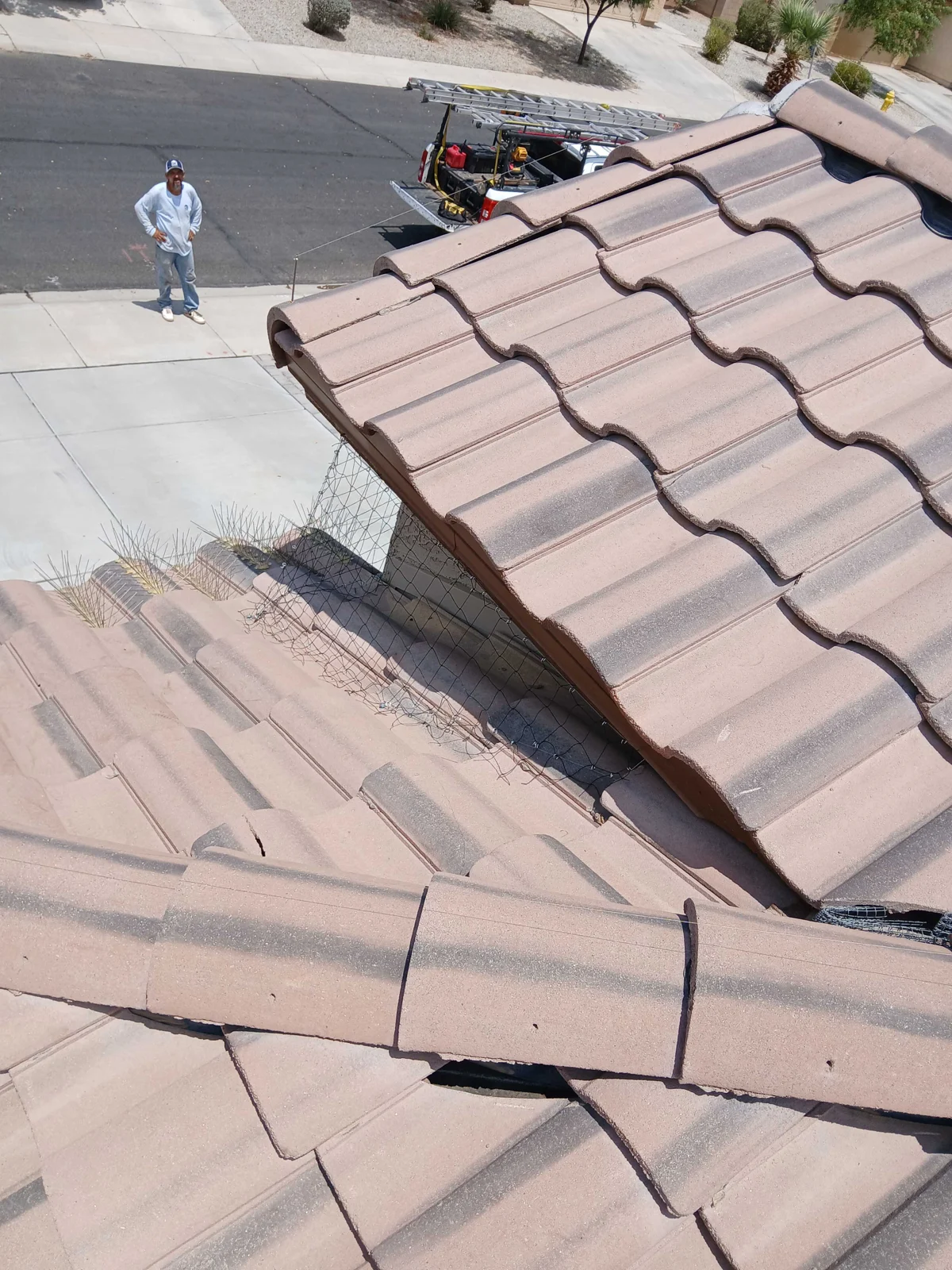
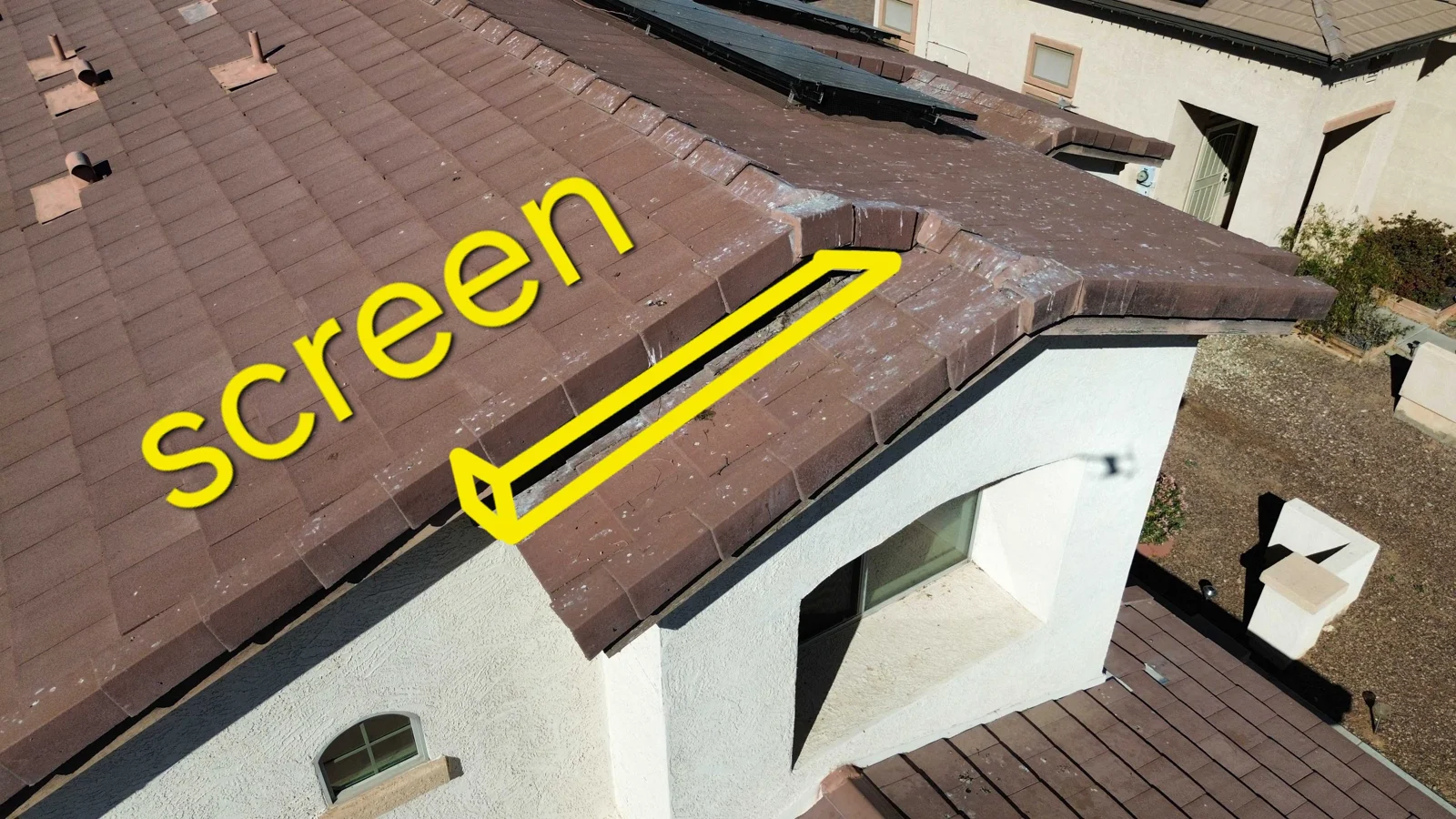
    A pigeon problem is not always centered on solar panels. Birds may be using a sheltered roof intersection, a recess behind a decorative tower, or a ledge that is difficult to see from the driveway. The droppings below can be more obvious than the space above them.

    When requesting pigeon removal, tell the inspector about these less-visible areas as well as the birds you see on the roofline. Understanding the layout of the problem helps define the work that is needed.

    Look for a pattern from the ground

    You may notice pigeons repeatedly disappearing behind the same part of the building. Another clue is a recurring patch of droppings beneath an overhang. Sounds above an entry or beside an upstairs room can help identify an area to discuss, although sound alone does not establish exactly where birds are nesting.

    Make a note of the location. A photograph from a safe ground-level position can help explain it. Leave roof access and a closer examination to the inspection.

    Distinguish the perch from the sheltered space

    A visible ledge and a nearby nesting recess are different parts of the property. An installation intended for the ledge may not close access to the recess. Similarly, protecting the edge of a solar array does not automatically address a separate roof intersection.

    Ask the inspector to explain which locations are being treated and what each part of the proposed installation is intended to do. This is especially useful when the building has several roof heights or decorative features.

    Ask about the full opening

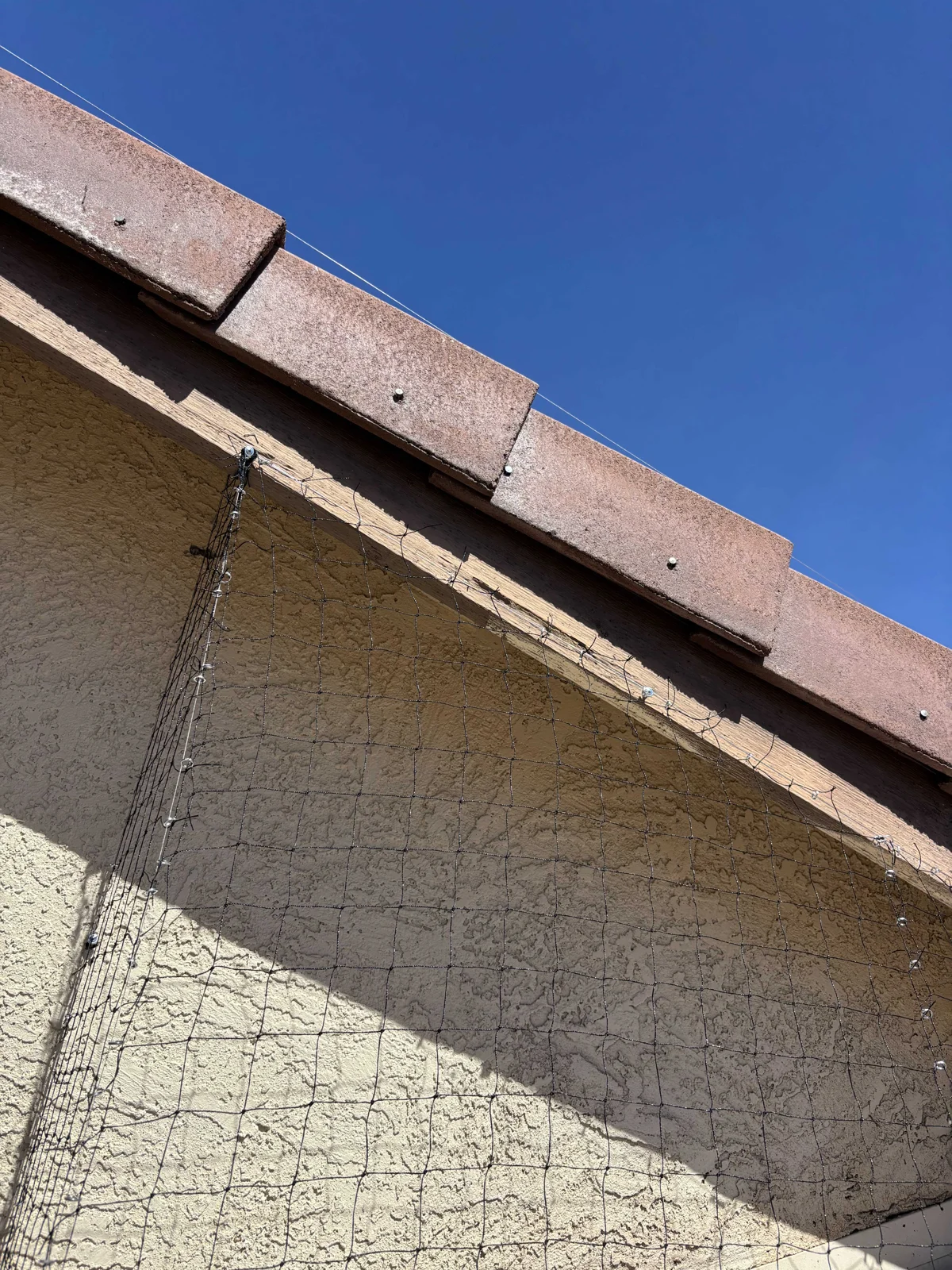
    For a recessed area, ask how the proposed protection will fit its shape. Corners, adjoining surfaces, and existing materials deserve attention. A useful estimate describes the area to be protected instead of simply listing a length of mesh or netting.

    The appropriate approach depends on the structure. Pigeon Pros Inc assesses the site before recommending screening, netting, or other deterrents. See our roof, eave, and ledge pigeon control options for an overview.

    Include cleanup in the conversation

    Ask whether the estimate covers the nesting material and droppings in the affected recess, along with any accessible surfaces below it. The cleaning method should suit the material, condition, and access.

    Cleanup and exclusion serve different purposes: one addresses the existing mess, while the other addresses access to the protected space. Our pigeon cleanup and nest-removal page explains that part of the work.

    Know what to report after the work

    If you see activity after an installation, describe the precise location. A bird standing on an unrelated roof edge is a different observation from a bird entering the protected recess. That distinction helps the company understand the concern and discuss an appropriate next step.

    Keep your estimate and any completion photographs so you can identify the treated areas. Ask about the written coverage for your project rather than assuming every part of the roof is included.

    Get the hidden areas checked

    If pigeons keep disappearing into a roof recess, request a free in-person inspection from Pigeon Pros Inc. We serve Phoenix metro homes and businesses. Call 480-888-8838 and tell us which part of the property is affected.

  • Pigeon Removal in Phoenix Metro: How to Prepare for Your Inspection

    If you are arranging pigeon removal, you do not need to know which material belongs on your roof or how many nests are hidden from view. Your most useful preparation is to describe what you have noticed and help the inspector understand access to the property.

    This checklist is for homeowners and property managers preparing for an inspection in the Phoenix metro area. It does not require getting on the roof or disturbing a nest.

    Write down where you see the activity

    Be specific about locations you can identify from the ground: above the garage, behind a front tower, beside the upstairs window, or along the edge of the solar panels. If the droppings collect in a different place from where the birds land, mention both.

    Describe how long you have noticed the activity and whether the birds return at particular times. You do not need an exact bird count. An estimate and a clear location are a useful starting point.

    Explain what has already been tried

    Let the inspector know about any previous cleanup, screening, netting, spikes, or other deterrents. If you have an earlier estimate or installation photographs, keep them available. Also mention recent roofing, painting, or solar work that may have affected access to the nesting areas.

    This helps the inspection focus on what is present now. It does not mean every existing installation needs to be replaced.

    Share access and scheduling details

    When arranging the visit, mention locked gates, pets, limited parking, or areas that require a property manager’s permission. For a commercial site, identify the person who can discuss access around deliveries, customers, or equipment.

    If the property is managed by an HOA or another owner, ask who must approve the proposed work. Have that conversation before setting an installation date. An inspection request is not a confirmed appointment until scheduling has been arranged.

    Ask how the removal plan fits together

    Use the visit to understand three things: where pigeons are using the building, what cleanup is proposed, and how those areas will be protected. Ask the inspector to explain any location that is outside the estimate.

    The phrase “pigeon removal” can cover different work. Our guide to pigeon removal services provides background, while our pigeon control process explains the sequence used to plan the work. Whether trapping is appropriate depends on the property and the control plan.

    Keep a few questions ready

    • Which areas are included in the estimate?
    • What cleanup and exclusion materials are proposed?
    • What preparation will you need from me before installation?
    • How will I know what work was completed?
    • What guarantee, if any, applies to this project?

    A written estimate should help you understand the work you are authorizing. Ask for clarification if a description is too broad to tell what will actually be done.

    Arrange your free inspection

    Pigeon Pros Inc offers free in-person inspections for homes and businesses across Phoenix metro. Send an inspection request or call 480-888-8838. Share your service address and what you can observe from the ground; we can discuss the rest with you.

  • Pigeon Control Near Me: What to Ask Before Hiring a Local Company

    Searching for “pigeon control near me” is usually the first step after noticing droppings on the patio, hearing birds above a bedroom, or seeing pigeons disappear into a sheltered part of the roof. The next step is choosing a company that can explain what is happening at your property and what its proposed work will address.

    Before comparing prices, ask a few practical questions. A clear inspection and written scope give you something more useful to compare than a promise to “get rid of the birds.”

    Will you inspect the places the pigeons are actually using?

    Tell the company where you see birds entering, where the mess appears, and whether the activity changes during the day. A cluster of pigeons on a ridge may be easier to spot than a nesting space behind a decorative tower. Ask whether the inspection will consider both visible perches and sheltered areas.

    You do not need to climb onto your roof to answer these questions. Observations and photographs taken safely from the ground can help you describe the problem.

    What does the estimate include?

    Ask the company to identify the areas it plans to clean and protect. If an estimate says “pigeon removal,” find out whether that includes nesting-material removal, droppings cleanup, screening, netting, or other deterrents. Ask whether existing damaged materials will be removed or repaired.

    A quote covering one roof recess is different from a quote covering several recesses, a solar array, and affected ledges. Make sure you understand the boundaries of the work.

    Why is this method suitable for my property?

    A useful explanation connects the proposed material to a specific part of the structure. Screening may close an opening; netting may protect a larger sheltered space; bird wire may be considered for an appropriate perch. Ask why each method has been selected and how the installation will fit the building.

    Our pigeon control services page explains the main options. The inspection determines which ones are appropriate for your situation.

    What happens if I notice activity afterward?

    Ask how to report a concern and what information the company needs. Find out whether a follow-up concerns a treated area or a different part of the property. Read the written guarantee rather than assuming it covers every location a bird might use.

    At Pigeon Pros Inc, a five-year guarantee is available in some cases. Ask which terms apply to your estimate before authorizing the work.

    Do you serve my address?

    A local search result is a starting point. Confirm that the company serves your address and can arrange an inspection. Pigeon Pros Inc serves homes and businesses across Phoenix metro, including Mesa, Gilbert, Chandler, Queen Creek, and Surprise.

    If you need pigeon control near you, request a free in-person inspection or call 480-888-8838. Tell us what you are seeing, and we will discuss the next step for your property.

  • Is Professional Pigeon Control Worth It? A Phoenix Guide

    Is Professional Pigeon Control Worth It? A Phoenix Guide

    Professional pigeon control is worth considering when birds repeatedly use a roof recess, solar array, or other space you cannot safely inspect and protect yourself. The value comes from identifying access points and installing suitable exclusion, rather than repeatedly chasing birds away.

    For Phoenix-area property owners, the decision should start with the location and scope of the problem. This guide compares practical maintenance you can handle from accessible areas with situations that call for an in-person assessment. Pigeon Pros has served Arizona since May 1999.

    For help at your property, explore our professional pigeon control services or see our Phoenix pigeon control projects and service information.

    When a professional inspection makes sense

    Consider an inspection if pigeons keep returning after cleaning, if birds disappear beneath solar panels, or if activity affects more than one part of the building. A sheltered nesting pocket can be difficult to identify from the location of the droppings alone.

    • Repeated activity in roof returns, sheltered ledges, or covered entries.
    • Access beneath a solar array or around rooftop equipment.
    • Old screening, netting, or spikes that no longer keep birds out of the intended area.
    • Several buildings or tenant areas that need one coordinated plan.
    • Work that requires roof access or specialist equipment.

    Take observations from the ground. You do not need to climb onto the roof to decide whether to request help. Photographs of the birds, entry locations, and affected surfaces can make the initial discussion more useful.

    What you can do before hiring someone

    Secure food waste, collect spilled pet food or birdseed, and note where birds are feeding. Tell tenants or family members about the plan so feeding does not continue elsewhere on the property. Report leaks or drainage problems to the appropriate maintenance person.

    These steps can support pigeon control, but they do not close an established nesting space. Avoid buying products solely because the packaging shows a pigeon. A product must fit the actual surface, opening, and bird activity to be useful.

    Compare the work, not just the product price

    The price of a roll of mesh or a strip of spikes is only one part of an installation. A proposal may also involve access equipment, attachment hardware, fitting around corners, cleanup, and arrangements for future maintenance. Ask for a written scope so you know what is included.

    Compare these items across estimates:

    1. Protected areas: which openings, ledges, canopies, or solar arrays are included?
    2. Cleanup: which surfaces and accessible nesting material will be addressed?
    3. Materials: what barrier or deterrent is recommended, and why does it fit?
    4. Attachment: how will the work account for the roof, equipment, drainage, and ventilation?
    5. Access: are lifts, tenant coordination, and equipment servicing needs included?
    6. Coverage: what written guarantee, if any, applies to this project?

    A lower quote for one roof recess cannot be compared directly with a quote for that recess plus several additional openings and cleanup. Resolve differences in scope before deciding which estimate offers better value.

    Price matching against our main competitors

    Pigeon Pros offers price matching against our main competitors. Bring the competing quote to us so we can review the proposed work and discuss the price match with you. Compare the protected areas, cleanup, materials, and access arrangements as well as the total price.

    What affects professional pigeon control cost?

    Access difficulty, building height, the number of affected areas, cleanup requirements, attachment surfaces, and the condition of existing materials can all affect the work. A small opening in a difficult location may require more preparation than a larger opening with straightforward access.

    Pigeon Pros provides a free in-person inspection so the recommendation reflects the property. This article does not assign a universal price or payback period. If you have already spent money on repeated cleanup or deterrents, share that history during the inspection so the remaining problem is clear.

    Why exclusion matters after birds leave

    Removing birds from a location does not by itself change the route back. A fitted exclusion system restricts access to the area it protects. Suitable options can include screening, bird netting, birdwire, spikes, or solar-panel perimeter screening, depending on the site.

    The space must be inspected before closure so birds are not enclosed. Required ventilation, drainage, and equipment access also need to remain available. Ask the installer to explain how those requirements are handled instead of choosing a method by name alone.

    Our inspection and pigeon control process explains how the proposed work is developed. For recurring activity after an installation, use our deterrent service information to understand the types of areas that may need assessment.

    Set realistic expectations for cleanup and coverage

    Confirm cleanup separately from exclusion. The estimate should identify what can be reached, which surfaces are included, and whether staining or building repairs fall outside the scope. See our pigeon cleanup service for more information.

    Ask which areas remain untreated. Birds on an untreated ledge are a different issue from birds entering behind a newly installed barrier. Completion photographs and a clear written scope help you report later activity accurately.

    Guarantee eligibility, duration, labor charges, and other conditions depend on the written project terms. Review our guarantee and coverage information and confirm what applies to your estimate.

    Frequently asked questions

    Is professional pigeon control always necessary?

    No. Basic accessible property maintenance can reduce attractions. Repeated nesting, difficult access, or a barrier installation calls for a more detailed assessment. A free inspection can help establish the scope before you commit to work.

    Will a professional guarantee a completely pigeon-free neighborhood?

    A project should specify the areas being protected and any applicable coverage. Excluding birds from your roof recess does not control their activity on surrounding buildings or untreated surfaces.

    What should I ask before approving an estimate?

    Ask which areas are included, how occupied spaces are checked, what cleanup is included, how materials will be attached, and what written guarantee applies. Also discuss future roof and equipment access.

    Request an inspection before buying more deterrents

    Request a free in-person pigeon control inspection or call 480-888-8838. Pigeon Pros serves homes and businesses across the Phoenix metro area and can explain options suited to the spaces birds are using.

  • Pigeon Control: 7 Steps to Keep Pigeons from Returning

    Pigeon Control: 7 Steps to Keep Pigeons from Returning

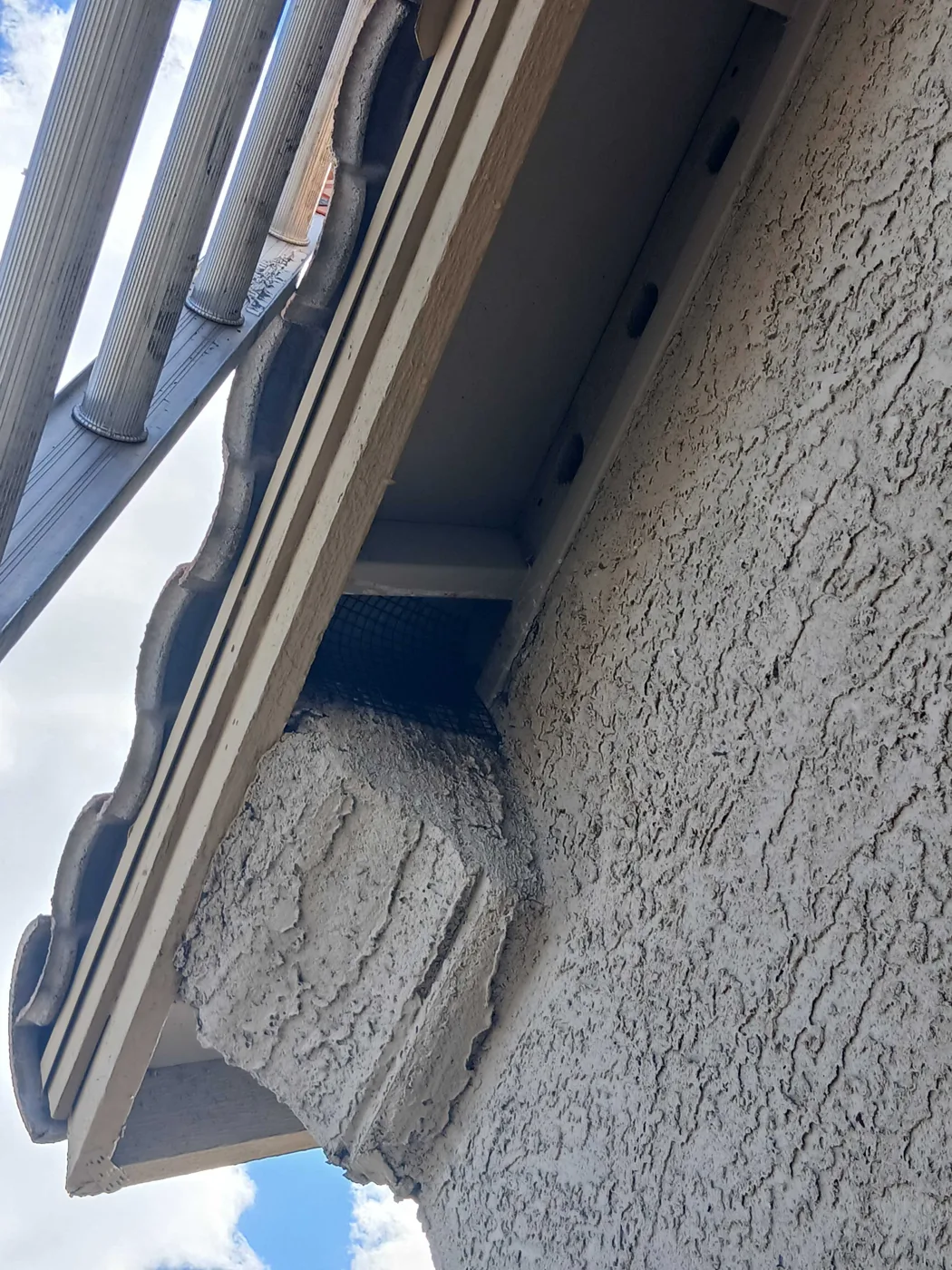
    To keep pigeons from returning, identify the spaces they use and block access with a properly fitted exclusion system. Cleanup and reducing food sources support the work, but they do not close an open nesting pocket.

    This pigeon control checklist is for Phoenix-area homeowners who have chased birds away, cleaned the same spot repeatedly, or tried a deterrent without lasting relief. Pigeon Pros has served Arizona since May 1999. These seven steps help you prepare for an inspection and maintain the areas protected afterward.

    For help at your property, explore our professional pigeon control services or see our Phoenix pigeon control projects and service information.

    1. Record exactly where pigeons return

    Watch from the ground or another safely accessible location. Note where birds land, where they disappear, and where fresh droppings collect. A bird sitting on a ridge may be nesting in a nearby roof recess rather than on the ridge itself.

    Photograph the same areas over several days. Tell the inspector whether activity is beneath solar panels, behind a sign, inside a roof return, or above a covered patio. These details help separate the access point from the mess below it. Avoid climbing onto the roof to investigate.

    2. Reduce accessible food and water

    Keep waste containers closed, collect spilled pet food and birdseed, and discuss intentional feeding with people using the property. Have leaks or drainage problems assessed where practical. Do not alter roof drainage or equipment to remove water.

    These changes can reduce attractions, but an established sheltered nesting space may remain attractive even when you stop feeding birds. Treat food management as part of the plan rather than a promise that pigeons will leave within a set number of days.

    3. Inspect concealed spaces before closing them

    An opening that appears empty from below may contain birds or occupied nests. Before screening or netting is installed, the full space needs inspection. Never seal birds behind a barrier. Ask how the installer will handle any birds or occupied nests found during the work.

    The inspection should also look for alternate entrances. Closing the most visible gap while leaving a corner open can allow continued access to the same space. Our pigeon control process starts with assessing the property before recommending a solution.

    4. Match the barrier to the problem area

    • Roof recesses and openings: fitted screening or suitable netting may restrict access to the sheltered space.
    • Covered patios and larger recesses: a netting system may be appropriate when a secure perimeter and maintenance access can be provided.
    • Exposed ledges: birdwire or spikes may suit specific perching surfaces when coverage matches how birds use them.
    • Solar arrays: suitable perimeter screening should account for brackets, wiring, airflow, and future servicing.

    Read more about pigeon deterrent installation and solar panel bird proofing. Ask why the proposed method fits your roof. A ledge deterrent will not close a separate opening under solar panels.

    5. Arrange cleanup as part of the scope

    Confirm which surfaces and accessible nesting material are included in the cleanup work. Tell the inspector about existing deterrents, staining, and any areas you cannot see clearly. Ask whether repairs to roofing or other building materials require a separate contractor.

    Cleanup removes existing material; exclusion addresses access. Having the roof cleaned without closing the nesting space leaves the route back available. Likewise, installing a barrier does not automatically include every cleanup task unless the estimate specifies it.

    6. Check the finished perimeter and protected areas

    Ask the installer to show you completion photographs and identify the exact areas treated. Corners, penetrations, uneven roof surfaces, and access panels deserve attention. Understand which nearby ledges or recesses remain untreated.

    Pigeons elsewhere on the roof do not necessarily mean a barrier has failed. Birds entering the protected space, a loose screen edge, or a gap opened during maintenance calls for a closer look. Document the location so the team can assess the specific issue.

    7. Recheck after roof or solar maintenance

    Let roof, solar, HVAC, and sign contractors know where exclusion materials are installed. After other work, check accessible areas for disturbed screening or netting. Do not remove or modify the installation without discussing how access will be restored.

    Keep your estimate and any written guarantee together. Guarantee eligibility and coverage vary by project; confirm the applicable terms rather than assuming every part of the property is covered.

    Common questions about keeping pigeons away

    Will a fake owl solve an established pigeon problem?

    We do not recommend relying on a decoy to protect an open nesting space. It does not physically prevent access. See our discussion of plastic owl deterrents before buying another scare device.

    Why are pigeons returning after screening was installed?

    Possible explanations include a remaining entrance, loose material, an untreated nearby space, or damage from later maintenance. An inspection is needed to distinguish these situations; seeing birds somewhere on the property is not enough to identify the cause.

    Can one installation protect the whole roof?

    That depends on the design and scope. Ask which openings and perching surfaces are included and which are outside the estimate. A barrier protects the area it encloses, not every nearby surface.

    Get a pigeon control plan for your home

    Pigeon Pros provides free in-person inspections across the Phoenix metro area. Request your free pigeon control inspection or call 480-888-8838. We will assess the spaces birds are using and explain suitable cleanup and exclusion options.

  • Professional Pigeon Removal in Phoenix: Residential Guide

    Professional Pigeon Removal in Phoenix: Residential Guide

    Professional pigeon removal in Phoenix should address both the birds using your home and the openings that let them return. A useful plan combines an inspection, appropriate cleanup, and exclusion designed for your roof or solar installation. Chasing birds away without changing access often leaves the underlying problem in place.

    This residential guide explains what to look for, what to ask an installer, and how to compare a proposed solution. Pigeon Pros has served Arizona property owners since May 1999. For local service details, see our Phoenix pigeon control page.

    Signs your home needs a pigeon inspection

    Repeated cooing near a roof recess, droppings collecting in the same place, and birds entering beneath solar panels are reasons to investigate. From the ground, note where birds land, where they disappear, and when activity is highest. Photos help an inspector understand the pattern without requiring you to climb onto the roof.

    Roof junctions, sheltered ledges, and spaces beneath equipment can provide nesting or roosting areas. Conditions vary from home to home: a system that protects one opening may leave a nearby recess accessible. An inspection should cover the affected area and other likely entry points.

    What a professional pigeon removal plan should include

    1. Inspect and identify: Locate access points, droppings, nesting material, and birds present. Identify the bird species and check for active nests before deciding how and when to work.
    2. Plan safe access: Consider roof condition, tile access, ladder placement, solar wiring, and protection of landscaping and walkways.
    3. Define cleanup: Specify which areas will be cleaned and how debris will be contained. Identify inaccessible material or repairs outside the scope.
    4. Install exclusion: Fit the chosen barrier to the opening while preserving required ventilation, drainage, and equipment access. Never close birds inside.
    5. Check the installation: Review edges, corners, and remaining access points, then document completed work with photos.

    Ask how the installer will handle an occupied nest or young birds. A humane plan needs an answer before work begins. Our pigeon control process explains how an inspection informs the proposed work.

    Pigeons under solar panels

    The sheltered space beneath a solar array can attract pigeons. Screening can block access, but the attachment method matters. Ask how the barrier will fit around brackets, conduits, and corners without interfering with the solar system or necessary airflow.

    Before approving work, confirm whether the proposed attachment method meets the solar manufacturer’s requirements and whether your solar provider needs to be involved. Do not assume drilling into panel frames or roof components is acceptable. The proposal should also explain how maintenance access will work after installation.

    See solar panel bird and pigeon proofing for this service. If panels or wiring appear damaged, have a qualified solar professional assess those components.

    Choosing exclusion for roof recesses and ledges

    Netting or fitted screening can keep pigeons out of sheltered spaces when the perimeter is properly secured. For exposed landing surfaces, a suitable deterrent may be part of the plan. The right choice depends on the opening, surface, bird activity, appearance, and maintenance needs.

    Ask for a clear explanation of why each product fits your home. A deterrent installed on a ledge will not necessarily stop access beneath a nearby solar array. Likewise, screening one recess does not address every roof junction. Review the whole affected area instead of choosing solely by product name.

    Removing accessible food and standing water, where practical, can reduce attractions around the property. These steps support exclusion but may not resolve established rooftop nesting on their own.

    Droppings and nesting material: arrange appropriate cleanup

    Avoid disturbing accumulated dry droppings or sweeping them into airborne dust. Cleanup methods should account for the amount of material, the work area, and exposure to dust. The CDC’s occupational guidance on controlling dust during cleanup explains why reducing airborne material matters.

    For substantial accumulations, enclosed areas, or work at height, ask a professional to assess the cleanup. Keep people and pets away from the work zone. Ask what surfaces are included, how waste will be collected, and whether stains may remain. Cleanup and roof repair are different services; damaged materials may need a roofing contractor.

    Learn more about our pigeon cleanup and nest removal service.

    What affects the cost of residential pigeon control?

    A quote depends on the number and size of openings, roof height and access, the layout of a solar array, the amount of cleanup, and the materials and attachment work required. Photos can help describe the problem, but an in-person inspection is needed to establish the actual scope.

    Compare written proposals by asking:

    • Which openings and roof areas are included?
    • What cleanup, materials, and attachment methods are specified?
    • How will birds or active nests be handled?
    • What is excluded, including roofing or solar repairs?
    • What follow-up is available if activity continues?
    • Which parts of the work qualify for a guarantee, and what conditions apply?

    Review the Pigeon Pros five-year guarantee and confirm the coverage for your particular proposal. Do not assume every product or service has identical coverage.

    After installation: watch the protected areas

    Observe the roof from the ground and report birds entering a protected opening, loose screening, or new droppings in the same location. Birds elsewhere on the property do not automatically indicate that an exclusion barrier has failed; the relevant question is whether they can still enter the protected space.

    Let solar technicians and roofers know that exclusion is installed before they work. Ask them to restore any disturbed barriers or arrange an inspection afterward.

    Residential pigeon removal questions

    Can I solve the problem by removing a nest?

    Nest removal alone leaves the access point available. The plan should address bird welfare, appropriate cleanup, and prevention of re-entry. Check occupancy before disturbing material or sealing an opening.

    Do I need to replace my solar panels?

    Pigeon activity does not by itself establish that panels need replacement. An exclusion installer can assess bird access; a qualified solar professional should evaluate suspected panel or electrical damage.

    Can you quote from a photo?

    A photo can show symptoms, but it may miss entry points, roof conditions, or material underneath panels. An inspection provides the information needed for a written scope.

    Arrange a Phoenix home inspection

    Contact Pigeon Pros for a free in-person inspection or call 480-888-8838. Tell us where you see activity, whether solar panels are present, and what work has already been tried so we can assess the next step.

  • Commercial Pigeon Control: A Property Manager’s Guide

    Commercial Pigeon Control: A Property Manager’s Guide

    A commercial pigeon control plan should identify the areas birds use, specify the cleanup and exclusion work, and explain how the installation will fit your building’s daily operations. For Phoenix property managers, a useful estimate answers more than the price: it shows what will be protected, how crews will access it and what maintenance remains afterward.

    Pigeon Pros has served Arizona since May 1999. We provide free in-person inspections for commercial properties across the Phoenix metro area. Use this guide when planning work for a storefront, office building, covered workspace or multi-building property.

    Start with a map of the pigeon activity

    Before comparing products, document where pigeons land, nest and leave droppings. A photograph of the mess below a canopy does not always reveal the nesting pocket above it. Signs, exposed beams, parapets and roof equipment can create several separate problem areas.

    • Identify entrances, walkways and work areas affected by droppings.
    • Note roof recesses, openings and ledges the birds use.
    • Record previous netting, screening or spikes, including visible damage.
    • Identify equipment that requires routine service access.
    • Tell the inspector about tenant complaints and previous cleanup work.

    Keep these observations at ground level or other safely accessible locations. Roof access and concealed spaces should be assessed by the people equipped to work there.

    Match the pigeon control method to each area

    Commercial pigeon netting can protect suitable covered spaces and exposed structural areas. It needs secure perimeter attachments, fitted edges and a plan for access where equipment will need servicing. A large opening and a narrow ledge generally need different designs.

    Screening may be appropriate for smaller nesting openings. Birdwire or spikes may suit particular ledges and perching surfaces. The deterrent installation plan should explain the choice for each location rather than assigning one product to the whole building.

    Before exclusion begins, check for birds and occupied nests so that animals are not enclosed. For installation and monitoring considerations, read our guide to humane pigeon control on business property.

    What should a commercial pigeon control estimate include?

    Ask for a scope you can compare line by line:

    1. Work areas: the specific openings, ledges or structures included, with photographs where useful.
    2. Cleanup: the surfaces to be cleaned, the accessible nesting material to be removed and any limitations.
    3. Materials and attachment: the proposed netting, screening or perch deterrents and how they will be secured.
    4. Access: roof access, lift requirements, parking restrictions and arrangements around customers or deliveries.
    5. Building coordination: how drainage, ventilation and equipment maintenance access will be preserved.
    6. Guarantee: the applicable written coverage, exclusions and any labor charges.

    A quote for one canopy is not directly comparable with a quote covering a canopy, roof recesses and several signs. Confirm the included areas before deciding which proposal fits your needs.

    What affects commercial pigeon control cost?

    The price depends on the protected area, access difficulty, building height, attachment surfaces, cleanup requirements and the condition of existing deterrents. Equipment access can be a significant part of the work even when the actual opening is small.

    For budgeting, compare the proposed project with your own cleanup history. Record repeat cleaning visits and staff time spent addressing the same locations. Exclusion may reduce recurring cleanup in protected areas, but no universal payback period applies to every building.

    Pigeon Pros prepares recommendations after an in-person inspection. The resulting estimate should reflect your property rather than an unsupported per-square-foot price.

    Coordinate cleanup with tenants and staff

    Pigeon cleanup and nest removal address the existing accumulation; exclusion addresses access to the nesting or roosting space. Confirm which tasks are included and how the area will be managed during work.

    Avoid having maintenance staff dry-sweep heavy accumulations before the inspection. Disturbing accumulated droppings can create airborne dust. The CDC’s workplace guidance describes dust reduction and other controls for this type of work. The cleanup approach and protective equipment should match the conditions.

    Keep a useful record after installation

    Retain the estimate, installation photographs, treated-area notes and guarantee documents. Give the relevant information to roof, HVAC, sign and solar contractors so later work does not unintentionally open the barrier.

    Check accessible areas for fresh droppings, loose material or birds inside an excluded space. A report that identifies the exact location is more useful than a general statement that pigeons are still somewhere on the property. Nearby untreated ledges may require their own assessment.

    Frequently asked questions

    Is netting always the best commercial pigeon deterrent?

    No. It can be suitable for larger protected areas, while screening, birdwire or spikes may fit other locations. Building geometry, bird activity and maintenance access determine the recommendation.

    Does the guarantee cover the entire building?

    Do not assume it does. Coverage depends on the written project terms and protected areas. Review Pigeon Pros’ guarantee and coverage information and ask which terms apply to your estimate.

    Can work be planned around business hours?

    Tell us about deliveries, customer access, tenant restrictions and equipment schedules during the inspection so the proposed work can account for those needs. Timing and access arrangements must be confirmed for the project.

    Request an inspection for your commercial property

    Request a free in-person commercial pigeon control inspection or call 480-888-8838. Pigeon Pros will assess the problem areas and discuss a plan for cleanup, exclusion and suitable deterrents.

  • How to Control Pigeons Humanely on Business Property

    How to Control Pigeons Humanely on Business Property

    Humane pigeon control starts with an inspection, a plan for any birds already using the space, and properly fitted barriers that prevent access to nesting and roosting areas. For Phoenix-area businesses, that means looking behind signs, beneath canopies and around roof equipment before installing netting or screening.

    Pigeon Pros provides pigeon control for homes and businesses across the Phoenix metro area. This guide explains the practical steps a business can take to reduce pigeon activity without creating hazards for birds, employees or customers.

    1. Identify the birds and occupied spaces first

    Do not cover an opening simply because you have seen pigeons nearby. Inspect the full space for birds, nests, eggs and young before closing access. A bird hidden behind a sign or inside a roof recess can be missed from ground level.

    Bird identification matters. Feral rock pigeons are not protected under the federal Migratory Bird Treaty Act, but many native birds are. The U.S. Fish and Wildlife Service explains the Act and its species lists. Do not assume every bird nesting on a building is a feral pigeon. Confirm the species and applicable requirements before disturbing a nest.

    If eggs, young birds or an uncertain species are present, have a qualified professional assess the situation and plan the work. Never seal birds inside a structure or behind netting.

    2. Reduce food and water that attract pigeons

    Property staff can help by keeping waste containers closed, cleaning up food spills and discouraging intentional feeding. Ask the maintenance team to address leaks or standing water where practical without interfering with equipment operation or required drainage.

    Coordinate with tenants so these steps continue after installation. Closing one dumpster does little if spilled food remains beside it. These changes support exclusion, but do not by themselves close an established nesting space.

    3. Choose barriers that fit the building

    Different locations call for different pigeon deterrents and exclusion methods:

    • Netting: useful for suitable covered areas, exposed beams and recesses where a complete barrier can be installed.
    • Screening or mesh: useful for specific openings and nesting pockets, with secure edges and appropriate attachments.
    • Birdwire or spikes: options for suitable perching surfaces. Coverage must match the ledge and the way birds use it.
    • Solar-panel screening: a separate perimeter solution for suitable arrays, with attention to wiring, access and attachment methods.

    A humane installation needs more than the right product. Netting must be fitted and secured so birds cannot enter through a loose edge and become trapped. Screening should preserve required airflow, drainage and maintenance access. Equipment and roof details should be assessed before choosing attachment points.

    4. Check the entire protected area before finishing

    The final inspection should include corners, penetrations, uneven surfaces and any access panels. Old deterrents or nesting material left behind a barrier can make the finished work difficult to inspect and maintain.

    Ask your installer to explain which areas are protected and which nearby surfaces remain accessible. Excluding one nesting pocket does not mean every ledge on the building has been treated. Clear expectations help you distinguish a repair issue from birds moving to a different untreated area.

    5. Plan cleanup and monitoring

    Arrange pigeon droppings and nest cleanup around the installation work. Keep staff and customers away from the work area and avoid disturbing dry accumulations. CDC guidance recommends reducing dust during work involving accumulated bird or bat droppings; see its workplace prevention guidance.

    After installation, record where birds are seen and where fresh droppings appear. Use photographs taken from the same safe location to compare conditions. Report a loose edge, damaged screen or bird inside an excluded space promptly. Inspect again after roof, sign or solar maintenance that may have disturbed the barriers.

    How quickly does humane pigeon control work?

    A completed barrier can restrict access to the area it protects immediately. Activity elsewhere depends on the building, nearby food sources and untreated roosting spots. There is no reliable universal timetable for clearing an entire property or changing the size of a neighborhood flock.

    This guide focuses on exclusion and property maintenance. It does not recommend a bait or fertility-control program, and those services should not be assumed to be included in an exclusion estimate.

    Frequently asked questions

    Is pigeon netting humane?

    It can be when the area is checked first, birds are not enclosed, and the netting is properly fitted and maintained. Loose or damaged netting needs attention because birds may enter or become entangled.

    Can staff install screening while pigeons are away?

    A temporarily empty entrance does not prove the space is unoccupied. Hidden nests or young may remain inside. Have the area inspected before closing it.

    Will cleanup alone stop pigeons returning?

    Cleanup removes the existing mess. It does not close a nesting opening or prevent landing on an untreated ledge. Pair cleanup with a plan for the locations birds are using.

    Arrange a free in-person inspection

    Pigeon Pros has served Arizona since May 1999. We assess the nesting and roosting areas and discuss suitable cleanup and exclusion work. Guarantee eligibility and coverage depend on the project; review the written guarantee details with your estimate.

    Request a free in-person pigeon inspection or call 480-888-8838. For larger installations, see our commercial pigeon netting service.

  • Pigeon Control & Removal in Tempe, AZ

    TEMPE, ARIZONA · REAL LOCAL PROJECTS

    Sheltered patio openings, entrance towers, and spaces beneath rooftop equipment can give pigeons places to settle. Pigeon Pros provides pigeon control and removal, cleanup, and bird proofing for Tempe homes and businesses. We inspect the areas birds are using and recommend a plan suited to the property.

    Serving Arizona since May 1999, we start with a free in-person inspection and explain the recommended work in your estimate. Explore four completed Tempe projects below.

    Request a free in-person inspectionCall 480-888-8838
    BEFORE & AFTER

    Four Tempe pigeon-control projects

    These photographs show four separate completed Tempe projects. Some inspection images include original work-plan markings. Camera angles and distances vary; each caption explains the view shown.

    PROJECT 01 · TEMPE, AZ · AUGUST 2026

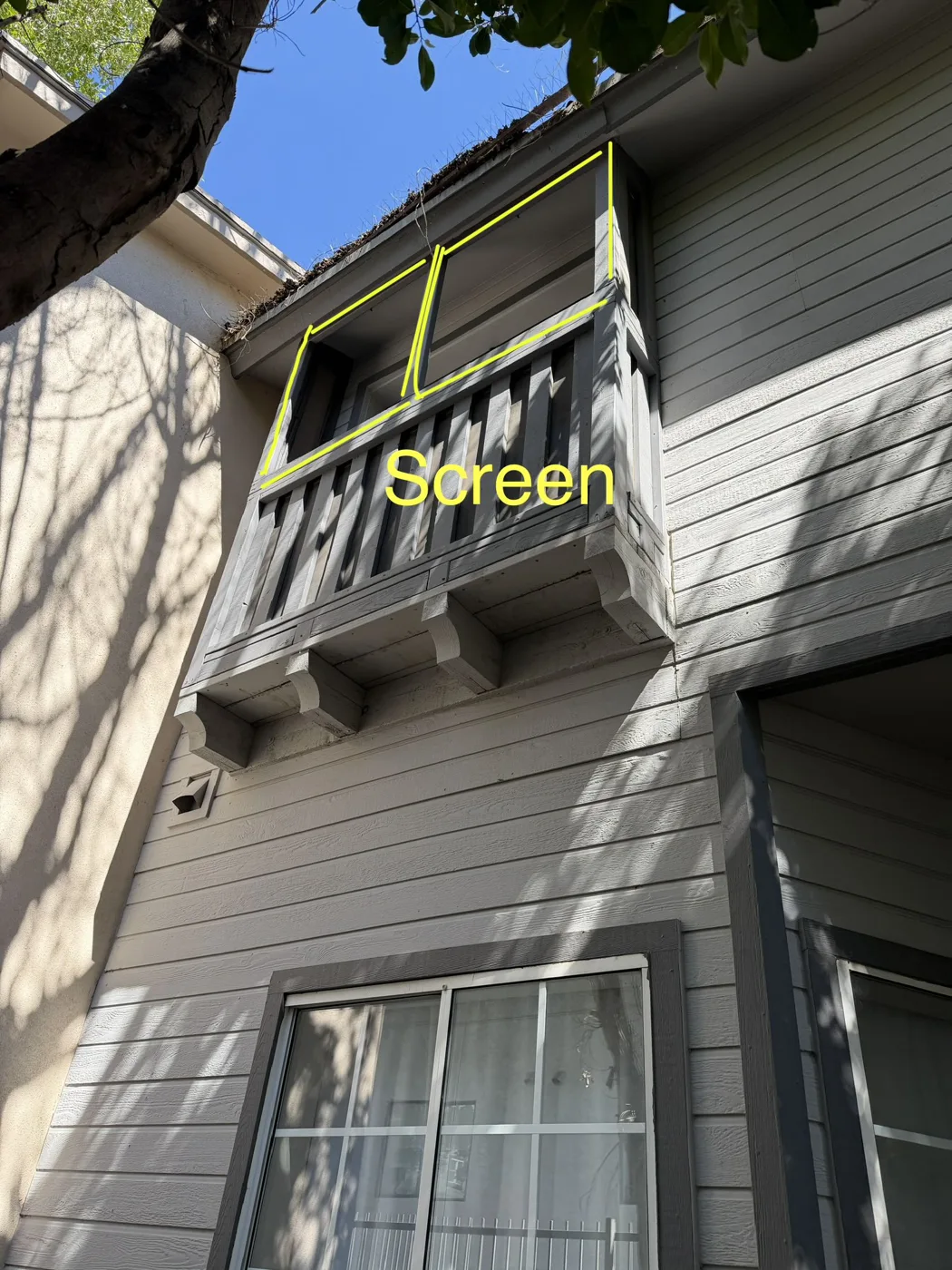
    Screen a sheltered patio opening

    At this Tempe property, the work focused on the back patio and roof immediately above it. Our crew pressure washed the affected areas and fitted half-inch PVC-coated screening across the open patio sections shown in the inspection photos.

    Before · inspection
    Tempe patio opening with inspection markings showing where pigeon-exclusion screening was planned.
    Tempe patio opening with inspection markings showing where pigeon-exclusion screening was planned.
    After · completed work
    PVC-coated screening installed across the upper patio openings at the same Tempe property.
    PVC-coated screening installed across the upper patio openings at the same Tempe property.
    PROJECT 02 · TEMPE, AZ · JULY 2026

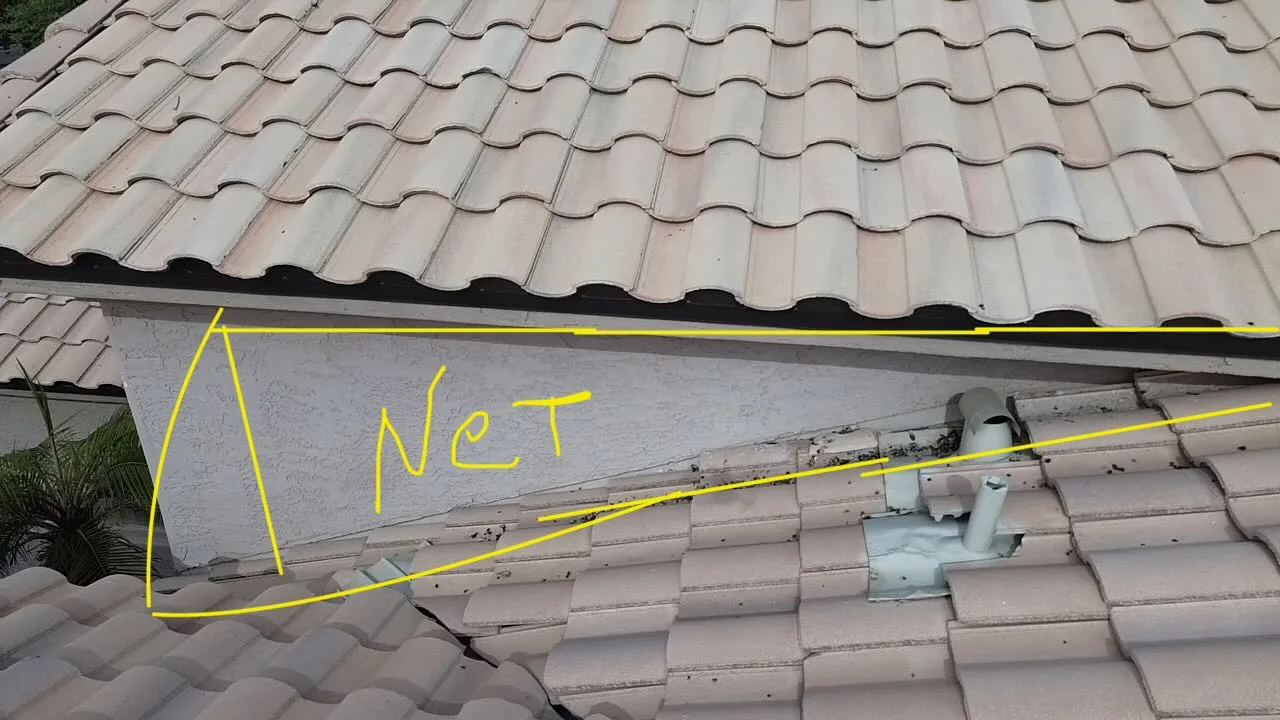
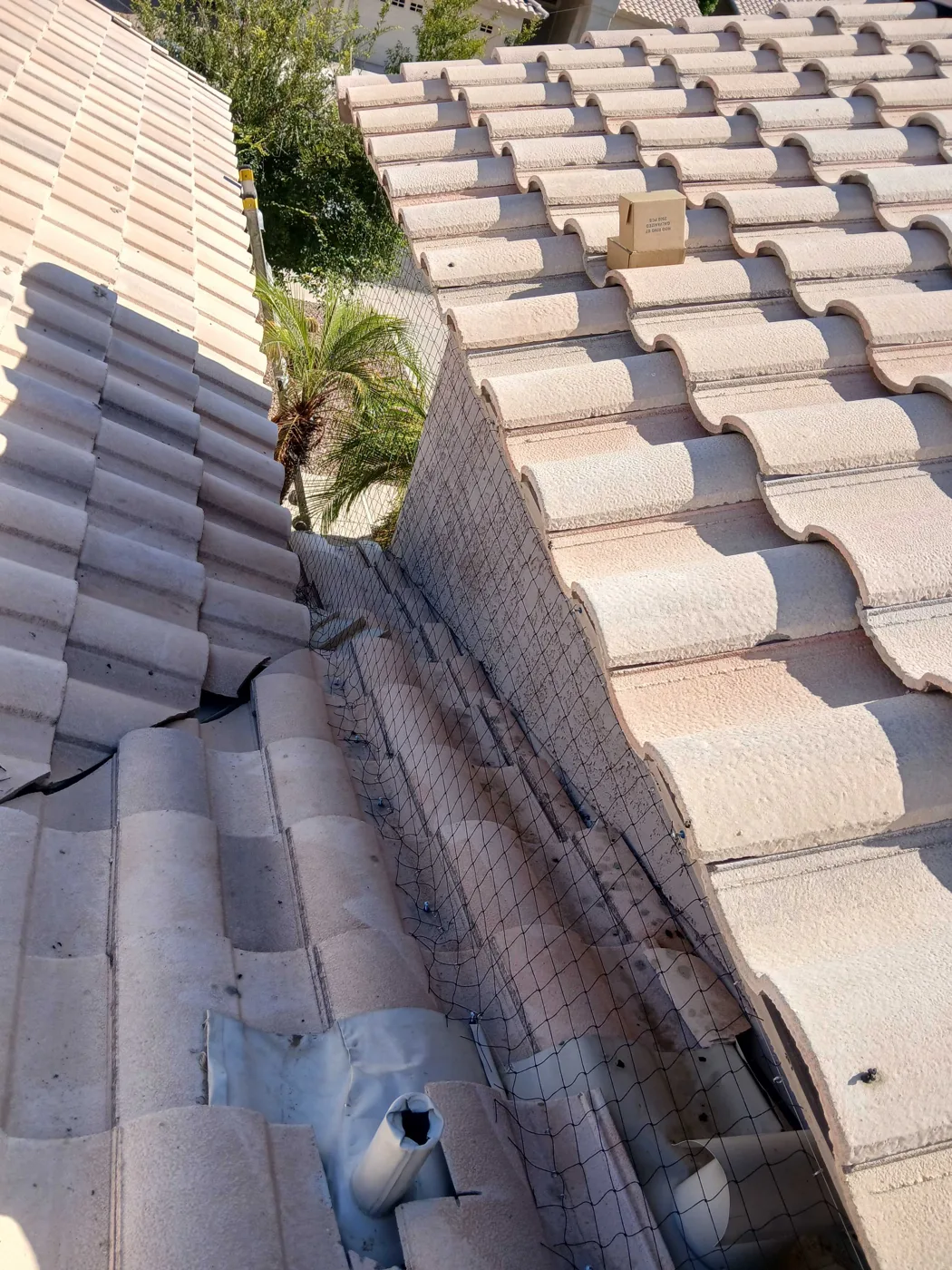
    Net the recesses beside an entrance tower

    This project combined pressure washing with black netting on both sides of the front tower above the entrance. Birdwire along the roof peaks and gables addressed additional perching surfaces. The selected photos show one of the tower recesses before and after installation.

    Before · inspection
    Tile-roof recess beside a Tempe entrance tower, marked for netting during inspection.
    Tile-roof recess beside a Tempe entrance tower, marked for netting during inspection.
    After · completed work
    Black pigeon netting fitted along the tower roof recess, viewed from the opposite end.
    Black pigeon netting fitted along the tower roof recess, viewed from the opposite end.
    PROJECT 03 · TEMPE, AZ · JUNE 2026

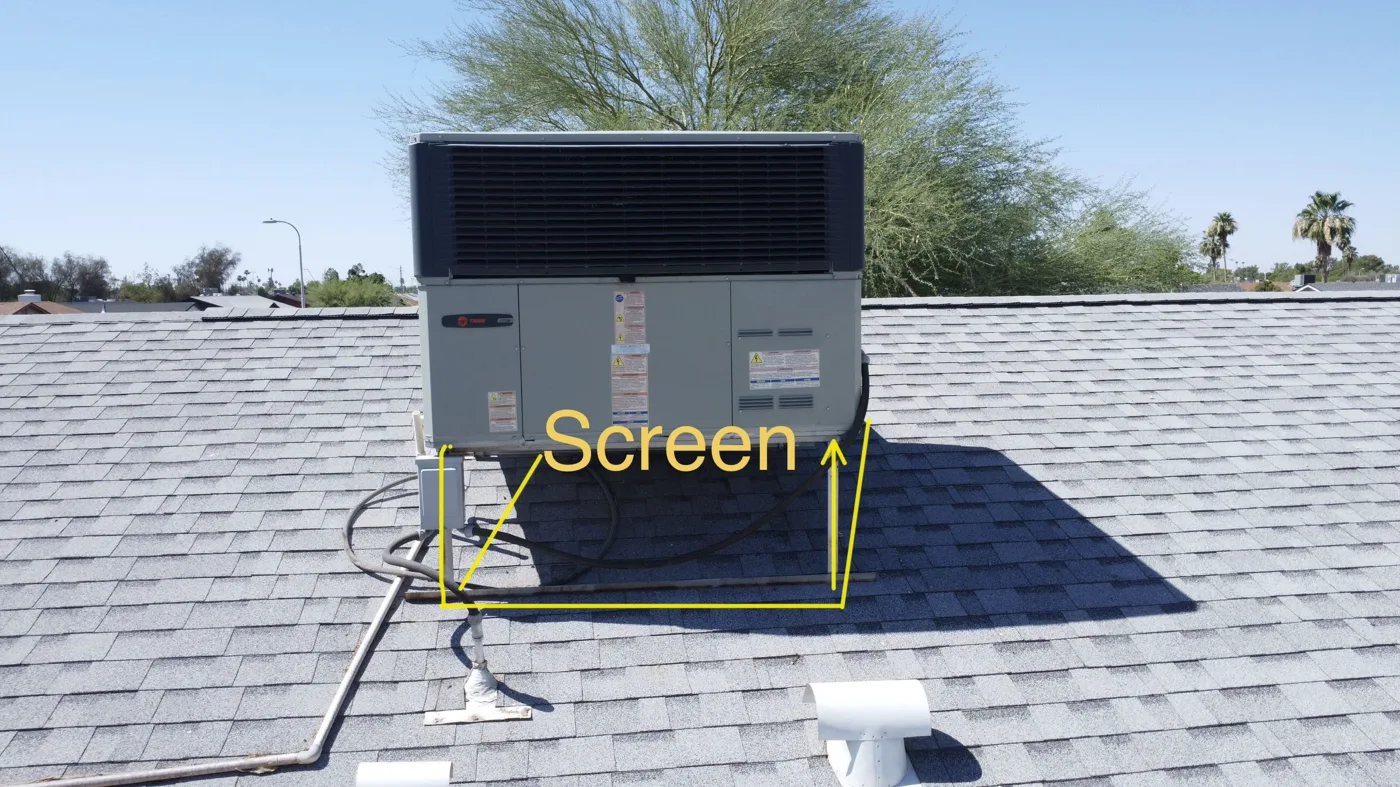
    Screen beneath rooftop equipment

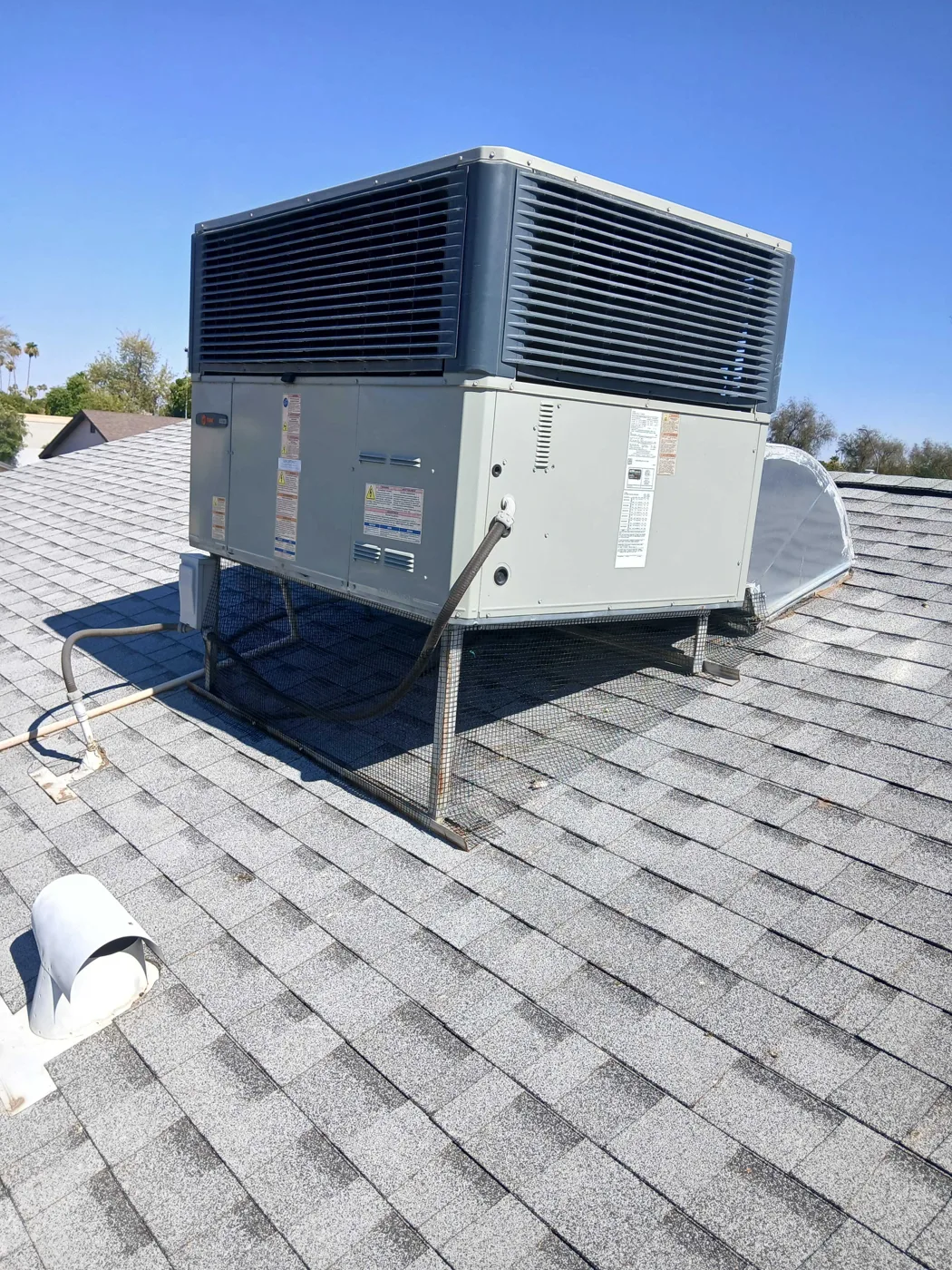
    Our crew removed loose droppings and nests, pressure washed the affected areas, and installed half-inch PVC-coated screening around the open space beneath the rooftop air-conditioning unit. The project also included screening at the back patio beams.

    Before · inspection
    Open space beneath a rooftop air-conditioning unit in Tempe, marked for screening.
    Open space beneath a rooftop air-conditioning unit in Tempe, marked for screening.
    After · completed work
    Pigeon-exclusion screening fitted beneath the rooftop air-conditioning unit after installation.
    Pigeon-exclusion screening fitted beneath the rooftop air-conditioning unit after installation.
    PROJECT 04 · TEMPE, AZ · JUNE 2026

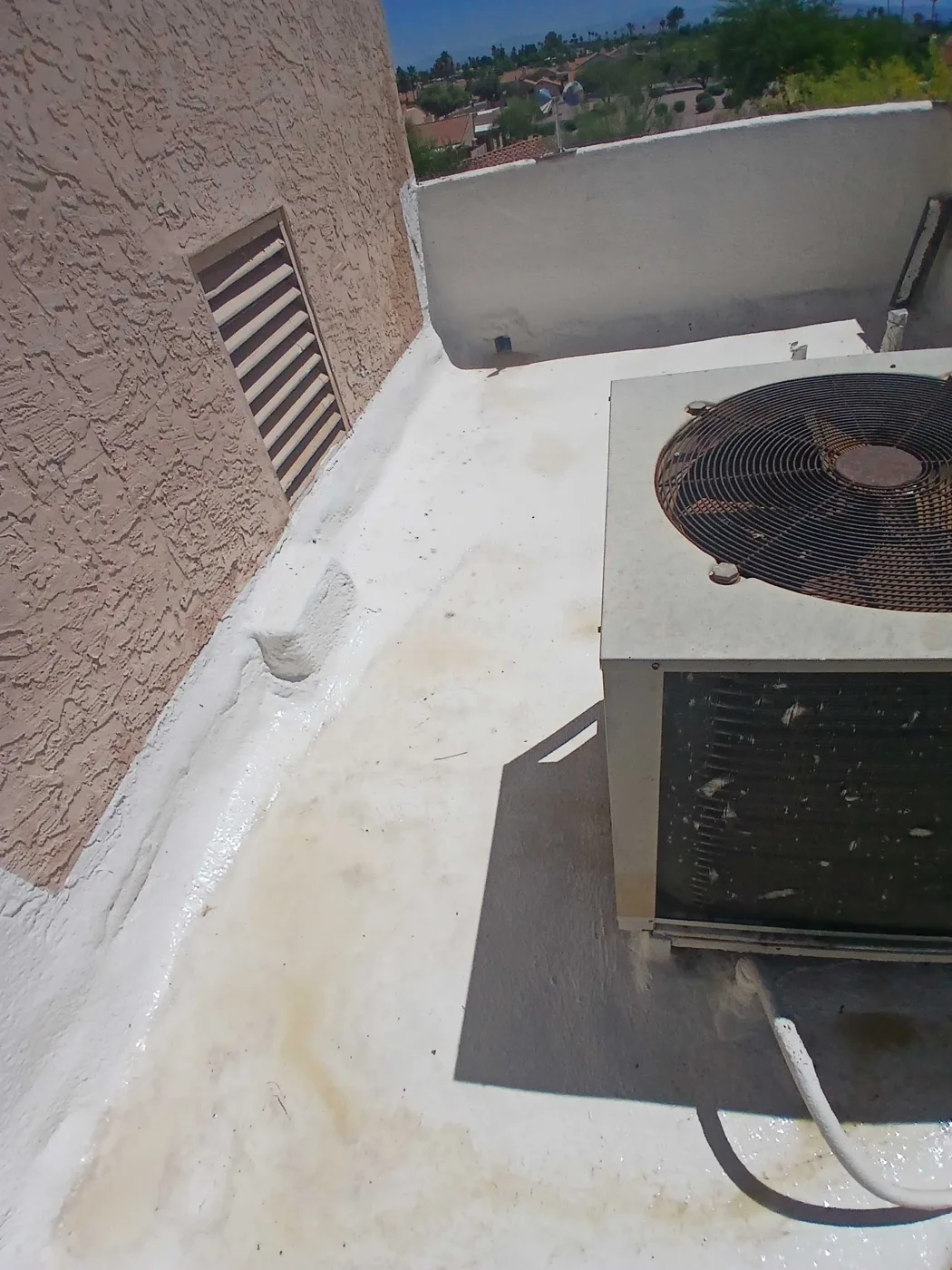
    Clean a flat-roof area as part of an exclusion plan

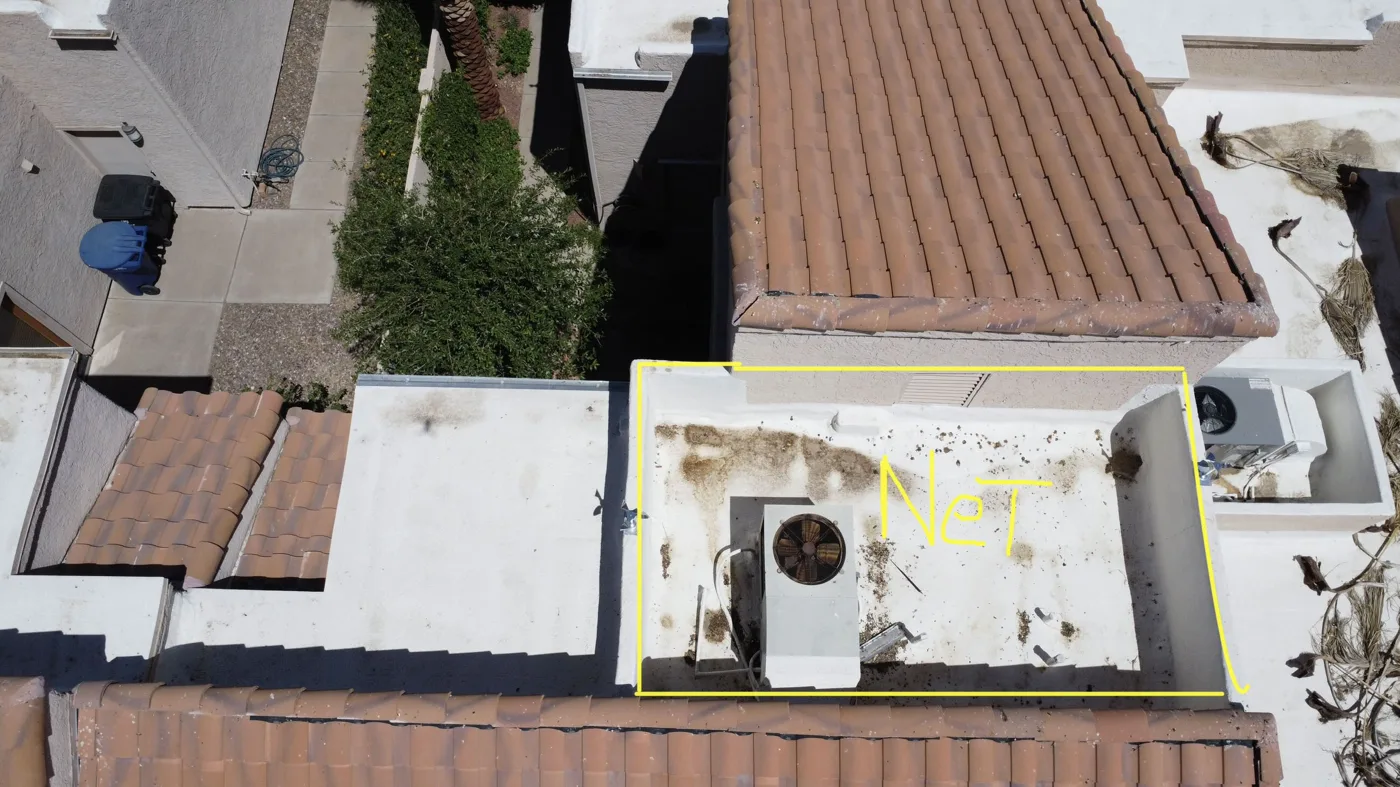
    This Tempe installation included nest removal, pressure washing, black netting, and stainless-steel birdwire. These photos focus on the flat-roof cleanup: an inspection overview with visible buildup and a closer completed-work view beside the rooftop equipment.

    Before · inspection
    Inspection overview of a Tempe flat roof with accumulated debris and markings for planned netting.
    Inspection overview of a Tempe flat roof with accumulated debris and markings for planned netting.
    After · completed work
    Cleaned flat-roof surface beside rooftop equipment at the same Tempe property.
    Cleaned flat-roof surface beside rooftop equipment at the same Tempe property.

    Pigeon control for your Tempe property

    Cleanup and nest removal

    We bag and remove loose droppings and nesting material and clean affected areas as specified in your estimate. Learn about our process.

    Eave screening and roof netting

    Screening and netting can close suitable openings and keep pigeons from accessing sheltered nesting spaces.

    Ledge and roof deterrents

    Birdwire and spikes address suitable perching locations. We select the materials and placement based on the structure and pigeon activity.

    Solar panel bird proofing

    If pigeons are getting beneath your solar panels, we can inspect the access points and recommend cleanup and exclusion. Explore solar panel pigeon proofing.

    Tempe pigeon control questions

    How much will pigeon control cost?

    The cost depends on the affected areas, access, cleanup, and materials needed. Request a free in-person inspection so we can provide an estimate for your property.

    What guarantee applies to my project?

    We explain the applicable workmanship, material, and pigeon-control coverage with your estimate. No-pigeon coverage is available in some cases and depends on the property and work performed. Read about our guarantee.

    Can you help when pigeons keep returning?

    Yes. We inspect nesting access and perching locations to recommend a suitable combination of cleanup and deterrents. Pigeon trapping and removal may be recommended when appropriate. Some properties need additional measures or follow-up work.

    Are these projects actually in Tempe?

    Yes. All four projects were matched to completed Tempe service records. The photographs show the original inspections and completed installations at those properties.

    Get help with your Tempe pigeon problem.

    Tell us where you are seeing pigeons. We’ll inspect the property and explain the recommended next steps.

    Request my free inspection480-888-8838
  • Pigeon Proofing Solar Panels: A Homeowner’s Guide

    Pigeon Proofing Solar Panels: A Homeowner’s Guide

    Pigeon proofing solar panels starts with an inspection, any needed bird removal and cleanup, and fitted mesh screening around the array. This barrier helps prevent pigeons from reaching the sheltered space beneath the panels while allowing ventilation. For Phoenix-area homeowners, the right plan depends on the roof, panel layout, and whether birds are already nesting.

    This guide explains solar panel bird proofing, what to look for in a pigeon guard, and the questions to ask before installation. For project photos and our installation process, visit our solar panel pigeon proofing service page.

    Why do pigeons nest under solar panels?

    The gap beneath a solar array offers shade and shelter. Pigeons may use that space for nesting and return to familiar access points. Cooing beneath the panels, birds repeatedly entering the same gap, and droppings around the array are reasons to arrange an inspection.

    An unprotected array does not mean pigeons will inevitably move in. Preventive solar panel bird protection is worth discussing when birds are active around your roof or neighboring properties, especially before nesting material and droppings accumulate.

    Your solar panels before pigeon pros
    Your solar panels before pigeon pros

    What is a pigeon guard for solar panels?

    A pigeon guard for solar panels is a barrier fitted around the accessible perimeter of the array. Pigeon Pros uses fitted mesh screening to block entry beneath the panels. The installation needs to account for corners, changes in roof height, and other gaps birds can reach.

    Effective pigeon solar panel protection is about the fit as well as the material. Ask how the screening will be secured, how ventilation and maintenance access will be preserved, and whether the proposed attachment method meets your solar installer’s requirements. Do not assume every guard or fastening method suits every panel system.

    How pigeon removal and solar panel proofing work together

    1. Inspect the array and surrounding roof

    The inspection identifies nesting activity, entry points, accessible debris, and other places pigeons use on the roof. Tell the technician where you hear birds and whether screening has previously been installed.

    2. Address birds, nests, and droppings

    When pigeons are already present, removal and cleanup need to be planned before screening closes their access. The estimate should explain which areas can be reached and what cleanup is included. Read more about pigeon cleanup and nest removal.

    3. Fit screening to the solar array

    Solar pigeon proofing closes the identified access points with fitted mesh screening. Cleaning alone leaves the sheltered nesting space available. Screening without assessing existing birds and debris also misses part of the problem.

    4. Review the completed work and coverage

    Ask which areas were treated, what maintenance is recommended, and what to do if you notice birds returning. Pigeon Pros offers a 5-year workmanship guarantee, with no-pigeon coverage available on a case-by-case basis. Review the guarantee and coverage details for your project.

    Your solar panels after Pigeon Pros
    Your solar panels after Pigeon Pros

    Real Phoenix-area work · Mesa, Arizona

    Two arrays. A whole-roof assessment.

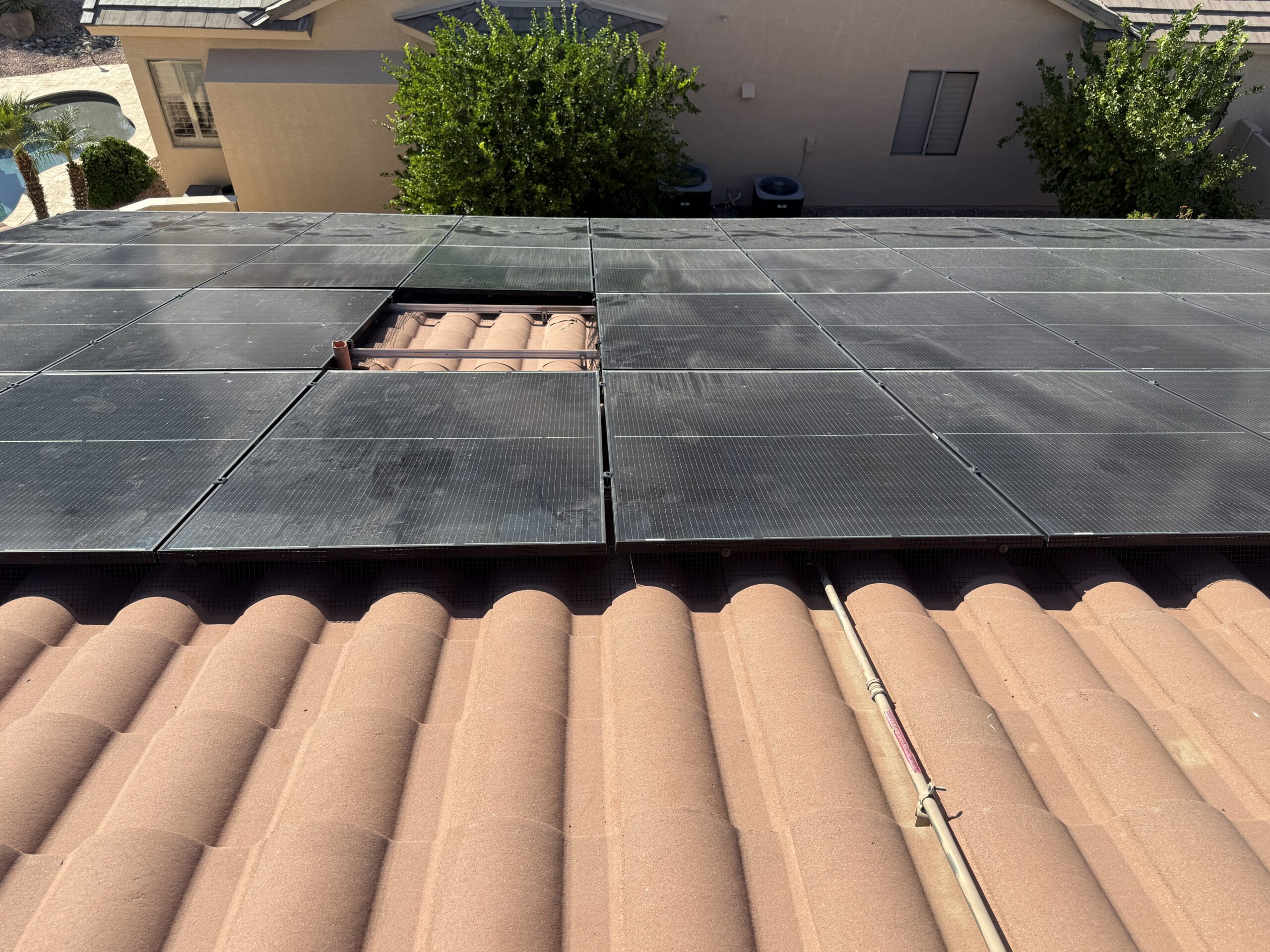
    Solar array on a Mesa tile roof after pigeon screening work by Pigeon Pros
    Solar array after screening work at a Mesa home.

    Our October 19, 2026 Mesa project included screening around two solar arrays, screening at four additional roof locations, and cleanup of affected roof and ground areas.

    The specified solar barrier was half-inch galvanized screening with a black PVC coating. That is this project’s documented material, not a promise that every property requires the same installation.

    Why it matters: protecting the space beneath the panels does not automatically close nearby roof recesses. The inspection should identify both.

    See the complete Mesa project →

    How much does pigeon proofing solar panels cost?

    The cost depends on roof access, the number and layout of the arrays, the perimeter that needs screening, existing bird activity, and the amount of accessible cleanup. Two homes with the same number of panels can require different amounts of work.

    When comparing estimates, ask whether they include inspection, bird and nest removal where needed, droppings cleanup, screening materials, installation, and follow-up coverage. Pigeon Pros Inc offers a free in-person inspection so your quote reflects your property.

    Compare the scope, not just the total

    Use these questions when reviewing a solar pigeon-proofing estimate:

    • Areas: Which arrays, edges, and other roof openings are included?
    • Cleanup: What nests and droppings can be reached, and what will be removed?
    • Barrier: What mesh and fasteners will be used, and how will corners and roof contours be fitted?
    • Solar access: How will ventilation, installer requirements, and later servicing be handled?
    • Coverage: What does the written guarantee cover, and who should you call if an opening appears?

    Solar panel bird proofing: common questions

    Should I pigeon proof solar panels before birds move in?

    Preventive screening can be considered before nesting begins. An inspection helps identify open access points and whether protection is appropriate for your array. You do not need to wait for a heavy buildup of droppings to ask about your options.

    Will cleaning the panels stop pigeons from returning?

    Cleaning addresses the existing mess but does not close the gap beneath the array. Solar panel bird protection combines any needed cleanup with a barrier fitted to the entry points. Routine panel cleaning and bird exclusion serve different purposes.

    Can I fit a pigeon guard myself?

    Roof access, the solar equipment, and existing nesting activity all need to be assessed. A guard must fit the array without trapping birds or interfering with the system. A professional inspection lets you discuss the installation and your solar installer’s requirements before work begins.

    Will bird proofing affect my solar-panel warranty?

    Warranty requirements vary by manufacturer and installer. Confirm the proposed materials and attachment method with your solar provider before installation. No general promise can cover every panel system or warranty.

    Does pigeon removal from solar panels include cleanup?

    The scope should be stated in your estimate. We assess accessible nests and droppings during the inspection and explain the cleanup included, along with any access limitations. Ask about both cleanup and screening when requesting a quote.

    Can pigeons still land on my roof after the panels are screened?

    Yes. Screening protects the treated space beneath the array; other ledges, roof peaks, and sheltered recesses may still attract birds. If activity continues, those areas may need a separate assessment. See our guide to pigeons on your roof.

    How long does solar pigeon proofing take?

    Timing depends on roof access, the array layout, existing birds, and cleanup needs. Ask for an expected installation timeframe during your inspection, including whether removal or follow-up visits are part of the plan.

    What maintenance does a solar-panel pigeon guard need?

    Ask what checks are recommended for the installed screening and contact your provider if an edge becomes loose or birds find a new opening. Tell your solar service company about the barrier before panel maintenance so any affected screening can be properly restored.

    Get a free solar pigeon-proofing inspection

    Pigeon Pros Inc has served Arizona since May 1999. We provide solar panel bird proofing across the Phoenix metro area, including Mesa, Gilbert, Chandler, Queen Creek, Surprise, and surrounding communities. Check our service areas.

    Tell us whether birds are already nesting, where you notice droppings, and whether your panels have existing screening. We will inspect the affected areas and explain the recommended work.

    Prefer to talk? Call 480-888-8838.

  • Pigeon Pros Reviews are Great!

    Pigeon Pros Reviews are Great!

    Pigeonpros logo
    Excellent service since 1999

    Don’t take our word for it. Here is what our customers Pigeon Pros reviews are saying recently:

    🌟🌟🌟🌟🌟 2 days ago New

    This is a terrific service! Highly recommend. The easiest and quickest company I have worked with in a long time. Estimate, communication, scheduling was fast and seamless. Team that did the work was fantastic. Super happy. https://g.page/r/CQ73AhDo2X01EAE/review

    Another Great Pigeon Pros Review

    🌟🌟🌟🌟🌟 5 weeks ago

    Since putting in solar panels our roof has been taken over my pigeons. For a couple years after every windy day or monsoon there would be pigeon poop all over backyard turf grass and all in the pool! I would have to literally use a shop vac to vacuum up the poop and also had to scrub clean our pool. BUT TODAY that all ended because I hired Pigeonpros They first cleaned out all the pigeon poop, feathers, nests etc from the roof and underneath all our solar panels along with solar panel cleaning. Then they set up screening around every solar panel and around other areas of our home. BILL & BODIE did an AMAZING job. They went above and beyond. Exceptional customer service too! I HIGHLY recommend this company for anyone else who may need their services. 🌟🌟🌟🌟🌟 rating for sure! https://g.page/r/CQ73AhDo2X01EAE/review

    Another 5 star Pigeon Pros Review

    🌟🌟🌟🌟🌟 6 weeks ago

    Bill and Bowdie at Pideon Pros really did an amazing job with my house! Cleaned up all the mess (BIG mess!) and put up some really nice deterrents! I’m looking forward to a lot less mess in the future! https://g.page/r/CQ73AhDo2X01EAE/review

    Get your free estimate today

    For a free estimate click here:

    We have 25+ Years experience in the Pigeon Control Industry Let’s take care of your pigeon problem today!

    🌟🌟🌟🌟🌟 4 weeks ago New

    Pigeon pros did a fantastic job at being consistent and making sure the customer is happy. They installed bird wire on all peaks or ridges, and installed the bird mesh. They continued to assure that what I needed done got done and to my satisfaction. Bill and Bowdie came to do the install and were very professional and courteous. It was obvious these two knew what they were doing and had the experience to do the job. Bill was also a long time roofer which is great when I had questions. I do recommend them and would prefer you request Bill and Bowdie to do your job.

    If you would like to read more Pigeon Pros reviews click here: https://pigeonpros.com/pigeonpros-reviews-and-testimonials/

    Read more reviews on Google: https://g.page/r/CQ73AhDo2X01EAE/review

  • Pigeon Control Buckeye AZ

    BUCKEYE, ARIZONA · REAL LOCAL PROJECTS

    Pigeons nesting in a shaded roof recess or beneath an eave need a solution that fits the opening. Pigeon Pros helps Buckeye homeowners and businesses with pigeon control, cleanup, and bird proofing based on an in-person inspection.

    Explore four completed Buckeye projects below, with actual inspection and installation photos from our crews.

    Request a free in-person inspectionCall 480-888-8838
    BEFORE & AFTER

    Four Buckeye homes. Four tailored solutions.

    Every project below is a different Buckeye property. Some inspection photos contain our original work-plan markings. Before and after views may use different angles to show the opening and the completed installation.

    PROJECT 01 · BUCKEYE, AZ · AUGUST 2026

    Close the hidden roof openings

    The inspection identified three openings that needed cleaning and screening. Our crew removed loose droppings and nesting material, pressure washed the affected areas, and installed half-inch black PVC-coated screening at the three spots.

    Before · inspection
    Annotated inspection photo showing the roof opening marked for cleaning and screening.
    Annotated inspection photo showing the roof opening marked for cleaning and screening.
    After · completed work
    Completed black screening fitted around the roof opening.
    Completed black screening fitted around the roof opening.
    PROJECT 02 · BUCKEYE, AZ · AUGUST 2026

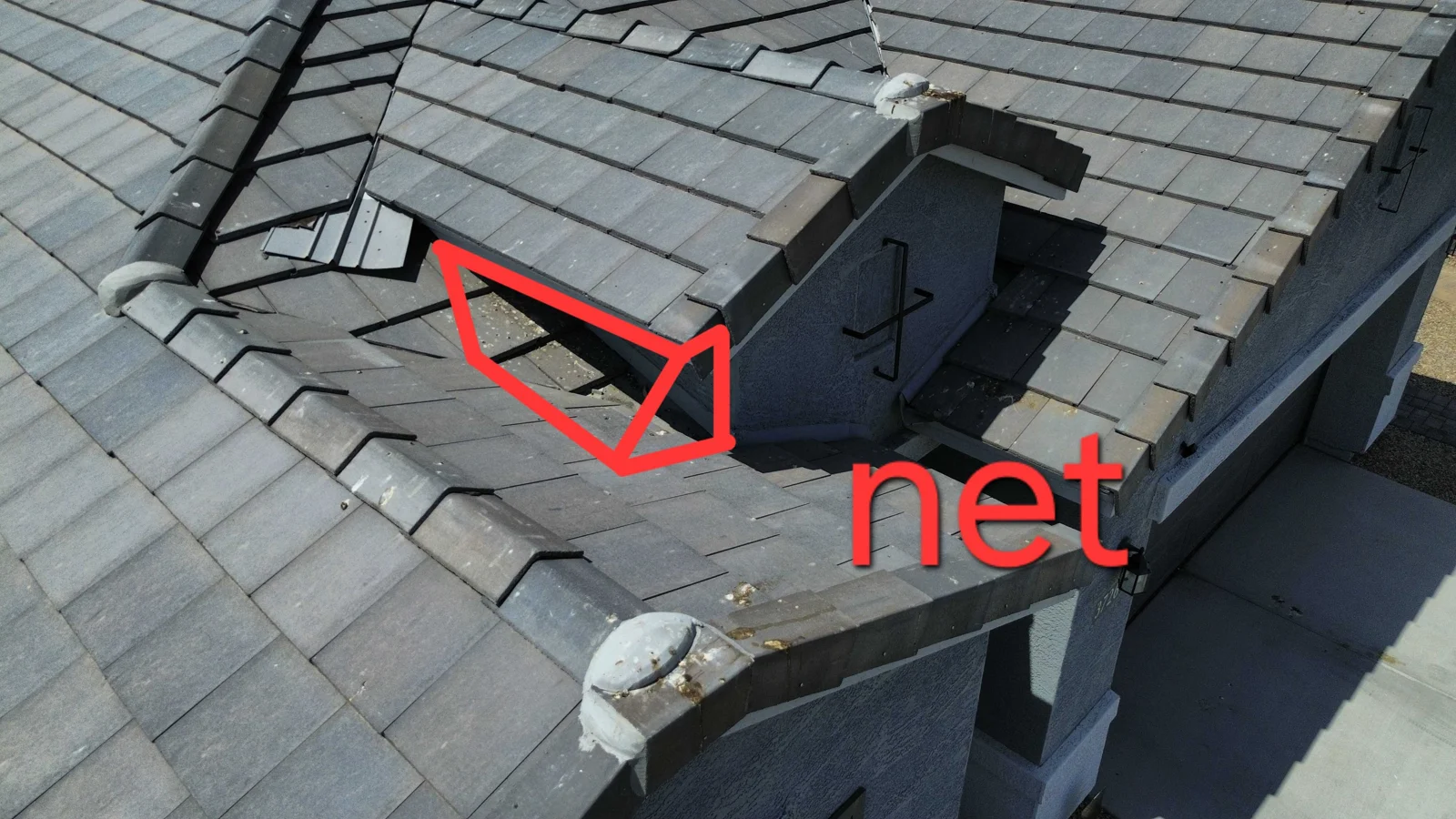
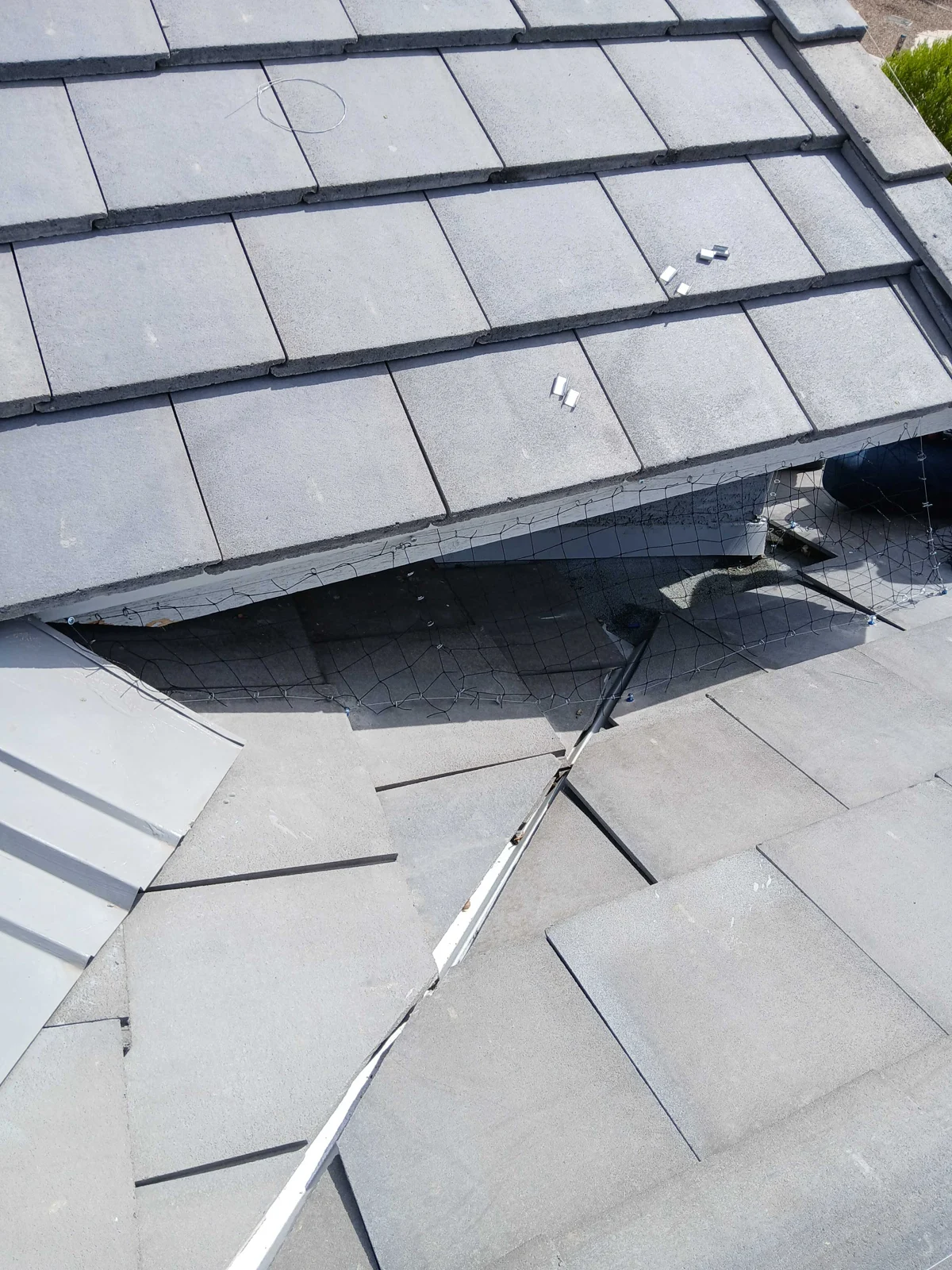
    Protect shaded roof areas

    This Buckeye project combined roof cleaning, netting across two large shaded areas, and birdwire along the roof peaks. The work addressed sheltered nesting spaces as well as exposed perching locations.

    Before · inspection
    Inspection photo marking a shaded roof recess for netting.
    Inspection photo marking a shaded roof recess for netting.
    After · completed work
    Installed netting across the roof recess, photographed from the roof.
    Installed netting across the roof recess, photographed from the roof.
    PROJECT 03 · BUCKEYE, AZ · JULY 2026

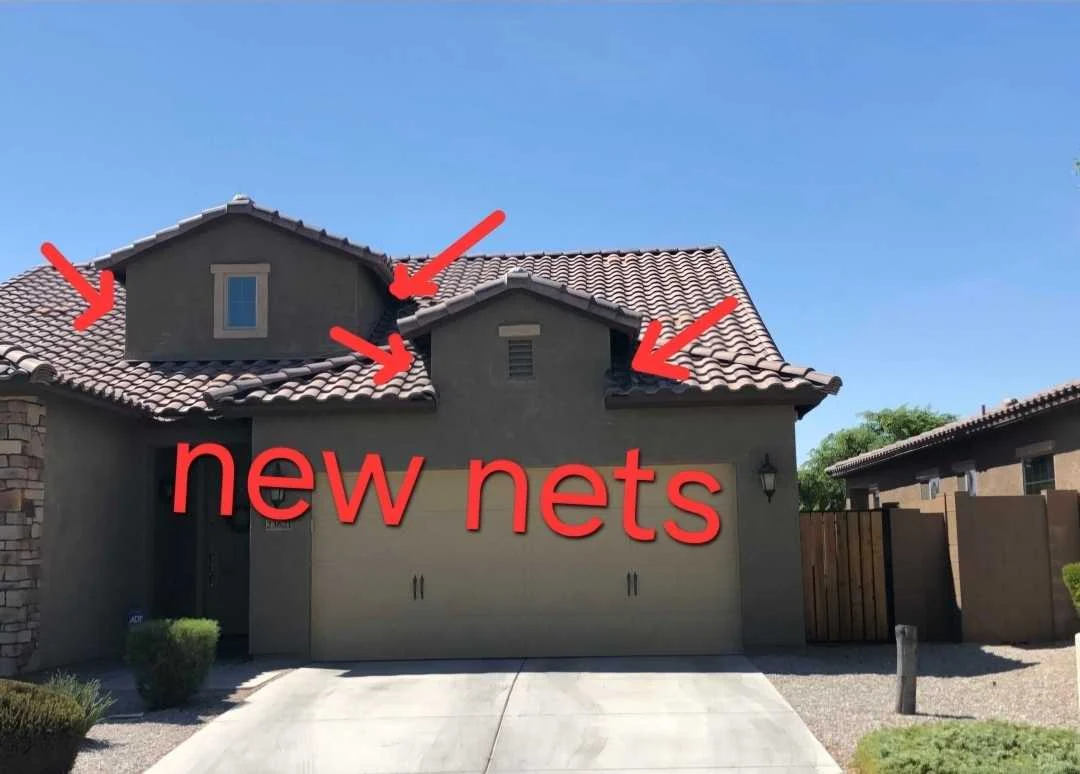
    Replace aging netting

    At this home, the work included nest removal, pressure washing, and replacement of four nets on the front of the house with new materials. The photos show the locations identified during inspection and a closer view of one completed netted area.

    Before · inspection
    Inspection overview marking the four locations planned for replacement netting.
    Inspection overview marking the four locations planned for replacement netting.
    After · completed work
    Close-up of a completed netted roof area after replacement.
    Close-up of a completed netted roof area after replacement.
    PROJECT 04 · BUCKEYE, AZ · MARCH 2026

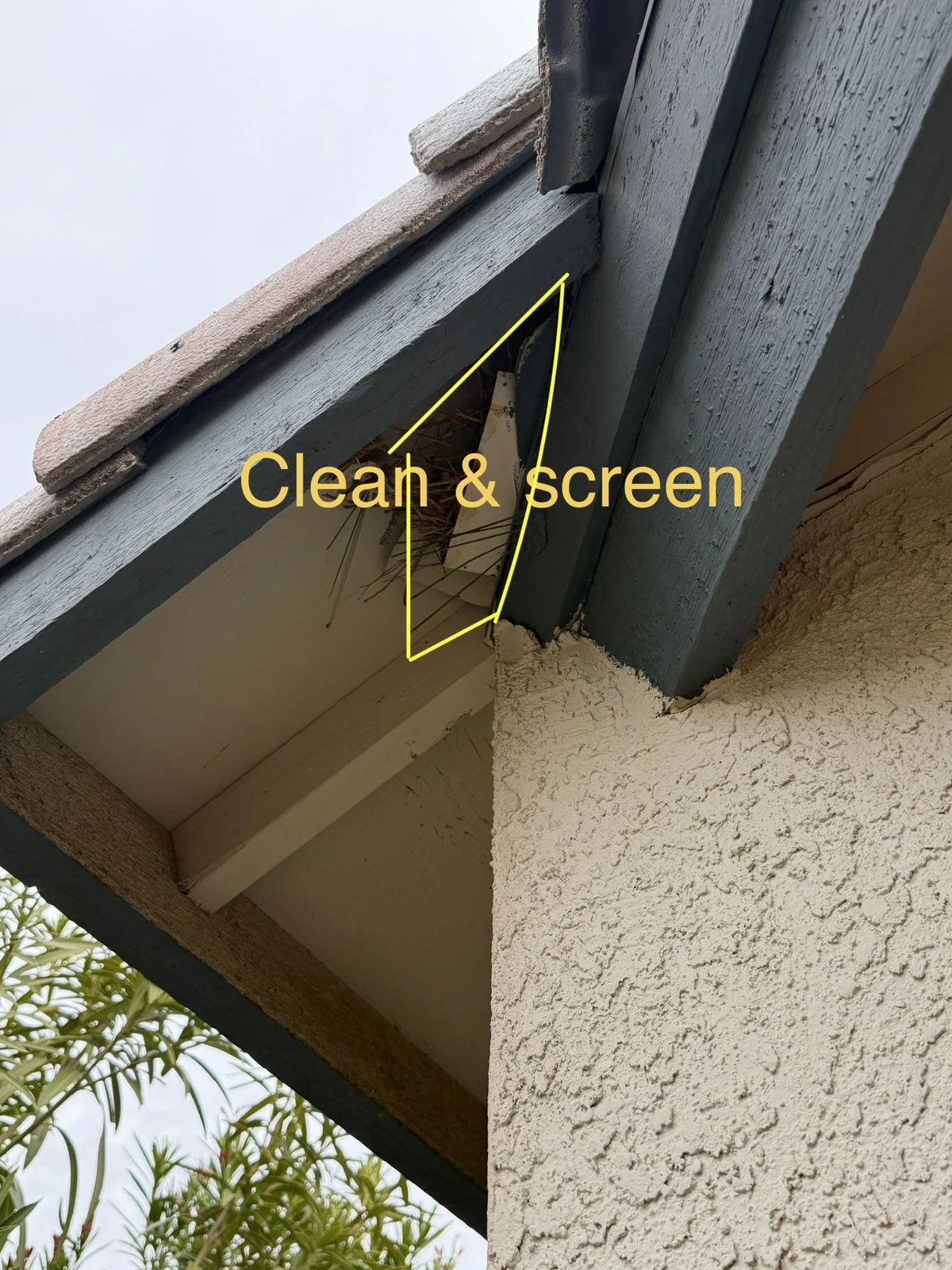
    Screen an eave as part of a broader plan

    This project included roof cleaning, screening one eave, netting a large shaded area, spikes on a window ledge, and birdwire on the peaks. The selected photos focus on the eave opening before and after screening. The job notes also identified trapping as a possible future step if needed.

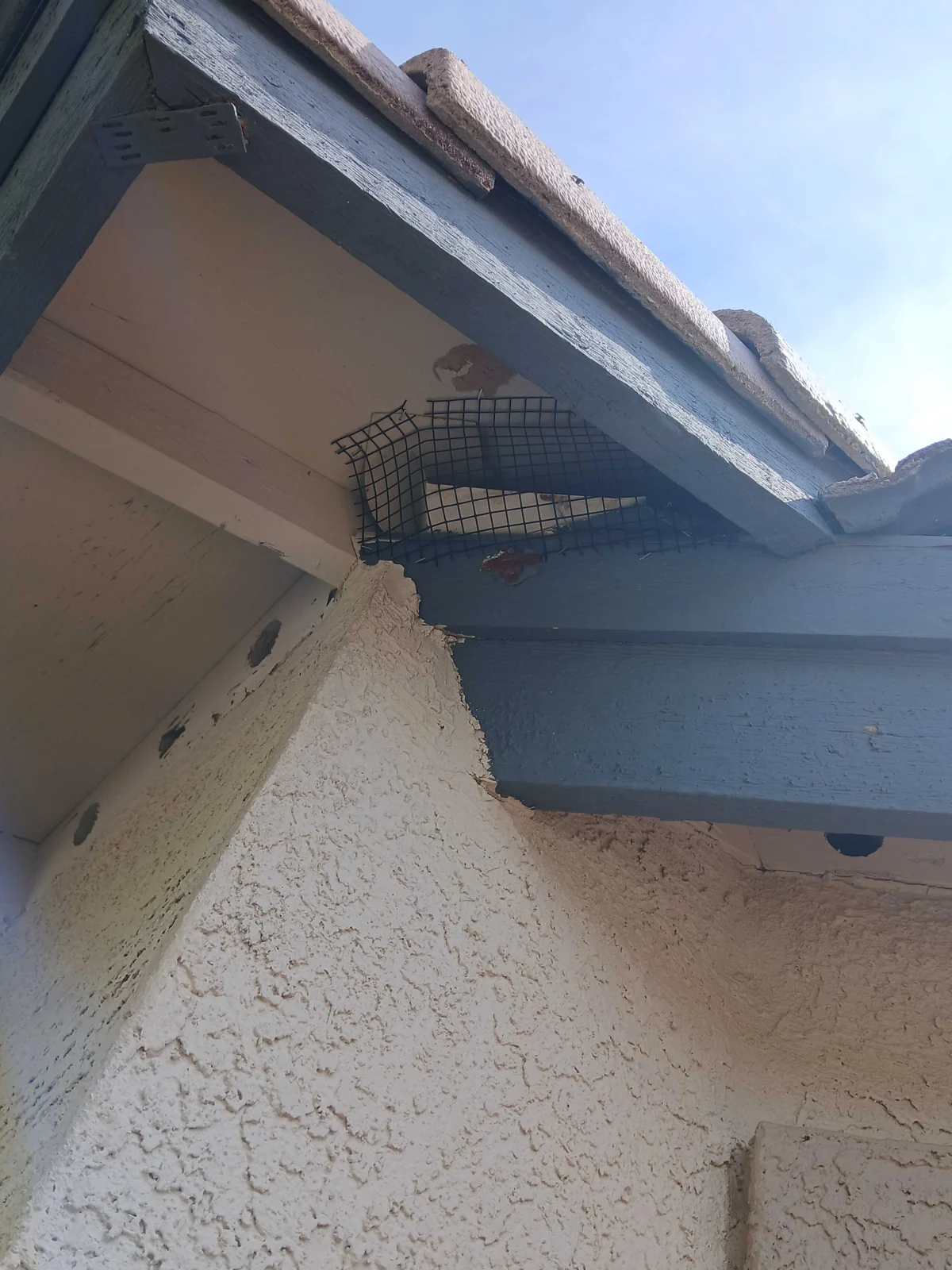
    Before · inspection
    Annotated inspection photo showing the long eave opening marked for screening.
    Annotated inspection photo showing the long eave opening marked for screening.
    After · completed work
    Completed screening along the eave opening.
    Completed screening along the eave opening.

    Pigeon control built around your property

    Roof cleanup and nest removal

    Remove accumulated nesting material and droppings from affected areas as part of the recommended work.

    Screening and netting

    Close suitable openings and protect sheltered spaces where pigeons nest or perch.

    Birdwire and ledge deterrents

    Address exposed peaks and ledges with deterrents selected for the structure and pigeon activity.

    Solar panel pigeon proofing

    If pigeons are getting under your panels, ask us to inspect the access points and recommend appropriate screening and cleanup.

    What happens at your inspection?

    We look at where pigeons are nesting, how they reach those spaces, and which areas need attention. We explain the recommended cleanup and exclusion work so you can understand the plan before scheduling installation.

    Can you help with pigeons returning to the same roof?

    Yes. The inspection helps identify nesting access, shaded areas, and perching locations. Depending on the property, the plan may combine several deterrents and may include trapping when appropriate.

    Does every project include a five-year guarantee?

    Coverage depends on the work and the property. A five-year guarantee is available in some cases; ask which areas and materials qualify when reviewing your estimate.

    Are these photos from Buckeye jobs?

    Yes. These four projects were matched to Buckeye service locations and completed job records in ServiceMonster. The photos show actual inspection views and completed work.

    Let’s look at your Buckeye pigeon problem.

    Tell us where you are seeing pigeons and request your free in-person inspection.

    Request my free inspection480-888-8838
  • Pigeon Cooing Is Annoying! Or Is It Just You?

    Pigeon Cooing Is Annoying! Or Is It Just You?

    What is pigeon cooing?

    Have you ever heard a pigeon calling out to another pigeon? Have you ever heard two pigeons making more pigeons? How would you know? Well, pigeons are famous for making a lot of racquet (noise). In fact, it’s a well known fact that pigeons will let you know if they are around. The more they are in an area such as your home or business, the more chance you already know what pigeon cooing sounds like.

    If you don’t have a pigeon problem near by it may be very cute to hear the familiar “coo, coo” call of a pigeon. Imagine to yourself or maybe you already have experienced this, Imagine hearing this sound constantly on a daily basis. 5 in the morning, 6, 7, and in fact at almost all hours of the daylight and into the evening.

    Pigeons will typically get started with cooing before sunrise. As the bird chatter begins with the first early morning dawn, so does the pigeon noise or cooing begin. The more comfortable a flock of pigeons is, the more you will hear them. Some people may find this sound relaxing and enjoyable, but when it is waking you up an hour before sunrise on the daily, it can quickly lose it’s charm.

    If you are hearing pigeons cooing constantly, you can bet that your pigeons are very comfy in their home above yours. If you are tired of all this constant cooing, we are ready to help. For more information about cooing, read on. Click here for a free estimate

    Why are pigeons cooing all the time?

    Pigeon Experts will remove pigeons
    Pigeons cooing as they take a bath together

    Why exactly do pigeons coo? Pigeons coo for several reasons, mating, calling partners, communication with other pigeons in the area, talking about food or nesting areas, Happiness, and distress. As far as we know, Pigeons are discussing the daily news. Pigeons are very gregarious and it adds to the complexity of the pigeon problem and pain that it causes our customers.

    A male pigeon will call out to attract their female partner. As pigeons mate for life, once a partner is found their will be constant communication in the form of cooing. It is possible our human talking sounds a lot the same to a pigeon, so who knows how complex their language is. Some websites claim that the tone and inflection changes in a pigeons voice depending on what is being discussed.

    Listen to different Pigeon cooing sounds

    Here is a link to hear a few different calls and coo’s from pigeons across the country. These calls were recorded in California, Texas and Pennsylvania. We can assure you the calls sound the same here in the AZ. Listen to pigeon sounds

    What can be done about the Pigeons cooing?

    If you would like to get rid of your pigeon problem, there are a few very important things you will need to take away from the pigeons.

    Take away their shelter

    First and foremost, the pigeons live at your property because they have a safe and sheltered place to build their nest and/or nests. These areas must be blocked off. Doing this can be difficult or easy. Every nest area is different.

    Take away their food

    The pigeons may have been drawn to your property in the first place due to something they are eating on your property. Observation here can be your best friend. Pay close attention to what the pigeons are eating and if possible eliminate that from your space.

    Take away their water

    Next, especially here in Arizona where we live in a desert, is their water source on your property? You can bet that just like you, the pigeons need water to survive. It’s currently 115 outside here in Phoenix and the birds are drinking water constantly, just like you would if you were trying to survive in the desert. If you can eliminate the water source on your property, it may help curtail the pigeon problem.

    Watch this sound device footage on our youtube channel

    Get help with your pigeons

    Many, many brave souls out in the World have tried to eliminate their own pigeon problem and failed. After endless cooing and droppings, they have had enough and try to eliminate the problem on their own. Pigeons are hard. No shame in trying, but we know how hard it is and we are professionals when it comes to eliminating a pigeon problem. Call us, email us, fill out this quick easy form and we will come out and quickly give you a free evaluation of your problem. Let get rid of your pigeons. We are ready to help.

  • Pigeon Removal Services

    Pigeon Removal Services

    Pigeon removal services in Phoenix and surrounding cities

    Pigeon removal services begin with identifying where birds nest, perch and enter sheltered spaces. Pigeon Pros provides property-specific inspection, cleanup and proofing for Phoenix metro homes and businesses. The right plan may combine nest and droppings removal with screening, netting or ledge deterrents; not every property needs every service.

    Looking for help at your property? Explore our pigeon control and removal options across Phoenix metro, or request a free in-person inspection.

    Pigeons are Homing Birds -What does that have to do with a pigeon removal services?

    Pigeons resting on a ledge in phoenix metro az courtesy Pigeonpros
    Pigeons rest on a ledge in phoenix metro az coutesy of Pigeonpros a local pigeon removal services company.

    If a pigeon had a preference it would live on our homes with us. In ancient times there was a real need to return an important message home. As such people would set out on their journey’s far from home with a pigeon that was born and raised at home. When the time came to send a message home it was simply tied to the leg of the pigeon and released. The pigeon would invariably return home to roost with the important message. In today’s world it is important to understand the biology of pigeons. This biology and instinct is what makes eliminating your pigeon problem so devilishly difficult.

    Pigeons do not Migrate

    Pigeons may repeatedly return to a familiar nesting or roosting area. Removing the mess without addressing access can leave the same sheltered space available again.

    Why do we need a Pigeon Removal Service?

    A recurring pigeon problem needs an inspection of the spaces birds are using. Our pigeon control process connects cleanup with suitable exclusion and deterrents, with the scope explained before work begins.
    Types of Pigeon Removal Services that are offered

    There are many types of Pigeon Removal Services offered Let’s get into the nuts and bolts of what services are offered and how they can eliminate your pigeon problems. Not all pigeon control services or pigeon removal services will be needed at every property and it’s very important to use the correct services and or products in the correct places.

    Ready for a free estimate?

    Pigeon Cleanup or Pigeon Poop cleanup

    check out the mess that came down from these solar panels in Phoenix AZ
    Pigeon droppings to the tune of 500 lbs come out from under these solar panels cleaned by pigeonpros in phoenix az

    Droppings, feathers and nesting material can accumulate around roosts, ledges and sheltered spaces. The amount of buildup and accessibility affect the cleanup scope. Ask which roof, patio and ground areas are included rather than relying on a fixed cleanup price for every property.

    Cleanup addresses the existing buildup. Screening, netting or suitable perch deterrents address the locations that allowed it to develop. Your estimate should explain both parts of the work.

    Pressure Washing

    After cleaning by the Pigeonpros in Phoenix AZ
    It was a lot of work to clean up over 500lbs of droppings at this home in Phoenix AZ but Pigeonpros got it done.

    Droppings and nesting material need to be removed before the affected surfaces can be cleaned and the protected openings closed. Cleanup addresses the existing buildup; exclusion addresses access to the treated space. Ask which roof areas, ledges, and accessible spaces beneath solar panels are included in your estimate.

    Pressure washing may be appropriate for some surfaces, but the cleaning method must suit the roofing material, its condition, and nearby equipment. High pressure can damage a roof when used incorrectly. Cleaning does not guarantee removal of every stain or repair damage that has already occurred.

    Sanitization or Sanitizing

    Ask which cleaning products and methods are proposed for the affected surfaces. Cleanup should suit the roofing material, its condition and nearby equipment. Your estimate should distinguish removal of loose material from surface cleaning and any additional treatment.

    Solar Panel Pest Abatement or Solar Panel Pigeon Abatement

    Your solar panels before pigeon pros
    Your solar panels before pigeon pros

    Solar panels have quickly become established as a tried and true method of delivering electricity to our homes and businesses. They have just as quickly become a favorite pigeon home for your pigeons. Pigeons love solar panels. The shade under solar panels is very cool. The supports under solar panels makes for great nest spots. Pigeons can quickly build multiple nests under your solar panels. The droppings can quickly accumulate leading to all sorts of problems.

    We install fitted screening around suitable solar arrays to limit pigeon access beneath the panels. Read about our solar panel bird and pigeon proofing service, including inspection, accessible cleanup and installation considerations.

    Your solar panels after Pigeon Pros
    Your solar panels after Pigeon Pros

    Installation of Pigeon Control or Pigeon Abatement

    One of the many things a pigeon removal service will do for you is to install pigeon deterrents or bird deterrents to control or eliminate your pigeon problem. Here are some examples of the deterrents that can be installed to eliminate your pigeon problem.

    Pigeon proofing methods at a glance
    MethodTypical applicationPurpose
    NettingCanopies, loading docks, and larger sheltered openingsCreates a barrier around the protected space.
    ScreeningSolar-array perimeters and suitable roof recessesCloses access gaps while allowing for the structure’s ventilation and maintenance needs.
    Bird wireSuitable narrow ledges and parapets with light bird pressureDiscourages perching on the treated surface.
    SpikesSelected ledges, beams, and signsLimits landing space; suitability depends on how birds use the area.

    Bird Spikes

    Most people have heard of Bird Spikes, or Pigeon Spikes. Spikes can be great if used correctly to eliminate your pigeon problem. Spikes are great for ledges, beams, and other narrow perching areas that pigeons love. Spikes do have their limitations however and when installed in the wrong place, you will still have a pigeon problem, but with spikes underneath it. Hiring a professional here can save you money and headache. Spikes should be a tool in the bag of all pigeon removal service companies.

    Pigeon Netting

    Pigeon Netting is a great way to protect large areas from pigeons. Pigeon removal services often require netting to protect areas from pigeons. Properly fitted netting creates a barrier around the treated space; condition, attachment and access openings matter. Pigeon netting is often the most affordable way to deal with huge pigeon problems. Areas such as docks, loading areas, commercial parking shades, walkways, outdoor eating areas, and other similar areas are places where pigeon netting makes sense. Example of a netting project

    Pigeon Screening or Pigeon Mesh

    Using a mesh, hardware cloth, screen etc. to block pigeons is a great way to eliminate a pigeon problem. All pigeon removal services employ this method to eliminate pigeon nesting and perching. The key here is to make it look good and functional. Any competent company will offer this service.

    Bird Slide or Pigeon Slide

    In some instances it may make sense to use a bird slide to prevent perching. This is a slippery surface installed at a steep angle to prevent pigeon access to a ledge or other surface. Your local pigeon removal service will know when it is appropriate to use this deterrent.

    Electric Shock Strips

    Just like people, pigeons do not enjoy getting shocked by a jolt of electricity. A few companies out there have invented shock strips to place along ledges and walls to shock the birds if they land. This is one way to prevent pigeons from landing on a structure. Your local pigeon removal service company will know when this deterrent is the right choice for you.

    Birdwire or Pigeon Wire

    Birdwire is a very cost effective way to reduce traffic on narrow ledges and other areas. Birdwire is meant for light bird pressure. Birdwire is a very good product when installed in the correct places. Birdwire works in two ways. First, the birds cannot see the wire and will actually bounce from it when trying to land. Secondly, Birdwire makes pigeons uncomfortable when they try to perch in the area and they just won’t stay. Birdwire is a product that will be frequently used by professional pigeon removal services.

    Pigeon Trapping

    Trapping and removal may be considered when appropriate for the property and pigeon activity. An inspection helps determine whether removal, exclusion, deterrents or a combination is suitable. Ask how the proposed work addresses the nesting spaces so that removal is not treated as a substitute for proofing.

    Pigeon Removal Services near you

    Pigeon Pros has served Arizona since May 1999. Explore local service details and completed projects for Phoenix pigeon control and removal, Peoria pigeon control, Gilbert pigeon control and Chandler pigeon control. See how we screen sheltered roof openings in Queen Creek and protect covered patios in Surprise. Request a free in-person inspection for a written estimate explaining the affected areas, proposed work and applicable guarantee coverage.